



memory
Haiti, 1919
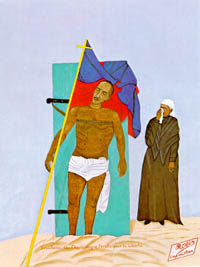 From Noam Chomsky, Year 501: The Tragedy of Haiti, 1993:
“The leader of the revolt [against the U.S. invasion], Charlemagne Péralte, was killed by Marines who sneaked into his camp at night in disguise. In an attempt at psywar that prefigured some of Colonel Edward Lansdale’s later exploits in the Philippines, the Marines circulated photos of his body in the hope of demoralizing the guerrillas. The tactic backfired, however; the photo resembled Christ on the cross, and became a nationalist symbol. Péralte took his place in the nationalist Pantheon alongside of Toussaint.”
The photograph was immortalized in 1948 by Philome Obin in his painting, Crucifixion de Charlemagne Péralte pour la Liberté.
Design Insurgency
With reference to this discussion, I’ve posted this condensed translation of the lecture notes presented by graphic designer Neville Brody and historian Stuart Ewen at the AIGA conference in San Antonio, September 1989. It appeared in the January/February 1990 issue of Print.
Design Insurgency
In its enthusiastic youth, design was invested with vision. Awestruck by futurism, swept by currents of modernity, design, it was claimed, could communicate new ideas about society, light the way to new and democratic ways of seeing.
Designers took part in great public debates over the fate of civilization. Design, they believed, could transform reality; it could help to deliver humanity from the social inequities of the past and give rise to a utopian future. Without such commitments — we were warned — design would merely lay a gloss across the face of barbarism.
These hopes have gone unrealized; the gloss is everywhere. Design is shackled by historical amnesia. The sense of social vision that once inspired it is but a dim memory. Obedient to the orders of corporate clients, designers are cogs in the wheels of commerce. They serve as pastry chefs in glorified soup kitchens, doling out mass-produced visual gruel.
 Design has little recollection that it once saw its role as one of creative communication; of exploding false outlooks and turning the world upside down. Instead, design is employed to discourage ideas, to bury thought. Design has become just a profession, an instruments of commercial guile, of calculated deceptions.
Empires were first based on a trade in raw goods; populations were dominated by the sword.
Empires were then built on manufactured goods; populations were disciplined by the clock.
Today’s empire is an Empire of Images; populations are led by their line of sight.
Design and Typography are the ways by which invisible goods are made visible.
In the rush for gold, design groups serve as armies of occupation in the battle for our minds; shock troops for the triumph of the superficial.
The impulse to mask the terms of social experience — or to offer images as a surrogate for experience — is reiterated again and again across the consumer culture.
Consumer society is mentally and culturally programmed to accept image manipulation. The packaging of abbreviated ideas jeopardizes actual thinking... critical thinking... common sense. Human subjectivity is cultivated as a resource for economic exploitation.
Life issues — social, material, environmental, spiritual — disappear from consideration amid a blur of disembodied representations. Within the dazzle of the spectacle, the real problems, needs and hopes of millions are made invisible.
In their lives, in the vernacular regions of popular expressions, people struggle to break through the din... to be seen... to be heard.
The trajectory of design follows the logic of an economy constructed of thin air. The manufacture of goods has given way to the manufacture of information. A “symbolic economy” — inflated by finance, credit and a global trade in abstract value — diminishes the notion of production for use. As one more negotiable currency, design decorates the acceleration toward catastrophe, transforming it into a persuasive conception of beauty before our eyes.
Design is propelled by the priorities of commercial gain. Wherever one turns, the capture of the eye is the preferred strategy of merchandising. All information is distorted by the means by which it is made appealing. “Good design” is defined as that which sells. Packaging overwhelms content. Our vistas are cluttered with images, yet — more and more — there is the unsettling realization that nothing is there.
In the uninterrupted flutter of changing appearances that characterizes the consumer culture, almost every form of representation bears a tenuous connection to matter, assuming — with increasing rapidity — the character of expendable currency.
One hundred thirty years ago, Oliver Wendell Holmes prophesied a culture of bodiless images about to take hold. “Every conceivable object of Nature and Art,” he wrote, “will soon scale off its surface for us. Men,” he predicted, “will hunt all curious beautiful grand objects, as they hunt cattle in South America, for their skills, and leave the carcasses [behind] as of little worth.”
This describes the practices of today’s style industries. Design is now the hunter. Fuelled by an economy predicated on planned obsolescence, design — like all commercial media — consumes every vision in its path. To create the impression of progress, of change, and of an “ever-evolving new,” predators of style prowl the terrains of human expression and creativity, desperately seeking surfaces to appropriate and sell.
The terrain of vernacular expression becomes contested ground; commercial colonizers and local populations struggle over the locus of meaning.
Design hijacks and recycles culture. Style is ripped from any source, and turns up in a place where it is least expected. Colliding world views are translated into design, images to be purchased. All faces are seen; few are given voice.
 Design no longer envisions, it advertises. Design no longer informs or educates, it blindly promotes the accumulation of wealth and power; it aestheticizers corporate greed and commercially motivated waste. Design is something to be used up. Its primary significance is that it will lose significance.
Whatever the “skin,” or its origin, its meaning is compromised — or lost — when it enters the realm of the style market. Within an ever-shifting tableau of design, all images send the same message: consume, use up, replace.
How a distributed message is communicated determines how it will be received, and how a message is received determines its form and structure.
Conforming to the logic of disposability, the most fundamental truth underlying an image is that it will soon cease to exist. While changes is design depict a charade of progress, the cultural garbage grows deeper and deeper. The perpetual waste of goods, the destruction of the earth’s environment, become acceptable norms. A trust in the promise of “the good life” requires an ever growing leap of faith.
Design is a hungry animal that constantly needs feeding, but it is using up its sources of reference. Culture is not a bottomless pit that can be endlessly ransacked. Design is in fact now eating itself through the last resort of self-reference.
Content can be dangerous. It can undermine the design message, the message that:
- packaging is all important;
- the image of the content is the content;
- there are no “goods anymore... only advertisements.”
We are no longer expected to read; only to recognize... respond... buy. Interpretation is stifled. Ideas are muted. Meaning gives way to presentation. Presentation creates a need; promises a fulfillment; closes the deal. Those that evoke the desire promise us the means of satisfaction. Packaging is the tool of a seduction.
Packaging seduces through a process of codification. Information and culture are delivered pre-codified, pre-digested, pre-packaged, ready-to-wear. Little is left to the imagination. Imagination is dangerous. It can imagine things not for sale. All power to the imagination!
At the heart of design lies an ethic of deliberate swindling. Images without bottom offer us fantasies of freedom: the freedom to be lifted out of the dreariness of necessity; the freedom to be who and what we wish; the dream of wholeness. According to the endless chain of visual ideas, satisfaction can be purchased across a retail counter... or from a catalog. Shopping replaces citizenship in the practice of democracy, and buying becomes the only remaining means of expression.
In the Empire of Image, typography, too, vies on the battleground of perception, seeking to shape and limit the vistas of possibility.
In the beginning there was the Word. In the end there was Typography. Words contain the power to persuade. Commercial uses of typography have hyper extended this eloquence. At the summit of this power stands the corporate logo: the ultimate exercise of typographical authority.
It is not the words we use, but how we display them. The initial message of written communication is its type style. The choice of typeface, weight, size and position dictates the emotional response to any piece of information or disinformation. Typography commands our attention. It lays claim to Truth. It propels the word past the barrier of reason... massaging, tantalizing, or alarming the psyche.
If you approach design purely as a solution to a problem, all you can ever hope to communicate is the problem itself.
In the world of advertising and design, a toxic society is daily rendered desirable. Tear it up!
The need for art and imagination to break free from the market has never been greater. It is a matter of survival. What is critically needed is a fresh approach to visual communication — a design insurgency — freed from the fetters of the “bottom line.”
Somehow, we must find a route towards the idea that design can be a meaningful response to people’s needs; more than an answer derived from a marketing question, more than a recycled skin.
Designers must assess the consequences of their work. The practice of design must be motivated by ongoing social concern. Designers must move beyond their drawing tables, step outside their Macs, reconnect their concerns to contours of popular experience and aspiration and establish a means for dialog.
Design today is approached as if selecting from a supermarket shelf. This reduces any element used to the meaningless, and leads to a state of pure ornament and gesture. Decoration is not a substitute for a good idea, and most design today works in the belief that the more you add, the better it is.
 Against the deluge of commercial icons, we must nurture voices of resistance, reopen the question of who has a say.
We are still using a typographic language that was created for a different society with different thoughts and ideals which it needed to communicate in a different way to ourselves.
We must find new languages; and rethink the world according to the needs of individual human communities. The dominance of surface over substance must be overcome. There needs to be a reconciliation of image and meaning.... A design insurgency.
Typography and design can be removed from the confidence games of consumer engineers, and become part of an organic process: affirming free thought, free expression, new social relations.
This can not be left to the wiles of “experts” or “specialists.” As long as design is defined as a profession — an insulated commercial priesthood — the public will be seen as little more than fodder for the market.
The requirements of community, the preservation of human and material resources, the liberating powers of education — not indoctrination — should stand at the center of the design process, guide its development.
True education must encourage social criticism, vision, creative self-expression, questioning, dangerous ideas... even subversion, where necessary.
If — like reading, writing, arithmetic — social and environmental awareness, visual literacy and critical design were elevated and encouraged in schools from an early age, more and more children would begin to master the means of visual communication.
Such education can then be carried on into the arenas and practices of everyday life.
On that day, people will move beyond consuming images. In the ensuing visual dialog, more voices will be heard, alternative possibilities will be acknowledged. The realm of public expression will step beyond the boundaries of commercial inducement, representing, and responding to, social, environmental and spiritual needs.
A democracy of expression will begin to nullify the power of packaged illusions.
Many of these themes appear a decade later in the 2000 re-issue of the First Things First Manifesto, an update to the 1964 declaration. The emphasis on individual, creative resistance reminds me of Adbusters, which began publishing the same year this speech was delivered. A compendium of Brody’s graphic design, The Graphic Language of Neville Brody was published a year earlier in 1988, as was Stuart Ewen’s work of cultural criticism All Consuming Images.
It’s interesting to compare the ideas expressed here with the work currently displayed on one author’s Web site. Plenty of exhuberent and expressive work, but I can’t find much social criticism or design in the public interest.
Orientation
From Beyond Vietnam: A Time to Break Silence:
“In 1957 a sensitive American official overseas said that it seemed to him that our nation was on the wrong side of a world revolution. During the past ten years we have seen emerge a pattern of suppression which now has justified the presence of U.S. military ‘advisors’ in Venezuela. This need to maintain social stability for our investments accounts for the counter-revolutionary action of American forces in Guatemala. It tells why American helicopters are being used against guerrillas in Colombia and why American napalm and green beret forces have already been active against rebels in Peru. It is with such activity in mind that the words of the late John F. Kennedy come back to haunt us. Five years ago he said, ‘Those who make peaceful revolution impossible will make violent revolution inevitable.’
Increasingly, by choice or by accident, this is the role our nation has taken — the role of those who make peaceful revolution impossible by refusing to give up the privileges and the pleasures that come from the immense profits of overseas investment.
I am convinced that if we are to get on the right side of the world revolution, we as a nation must undergo a radical revolution of values. We must rapidly begin the shift from a ‘thing-oriented’ society to a ‘person-oriented’ society. When machines and computers, profit motives and property rights are considered more important than people, the giant triplets of racism, materialism, and militarism are incapable of being conquered.
A true revolution of values will soon cause us to question the fairness and justice of many of our past and present policies. On the one hand we are called to play the good Samaritan on life’s roadside; but that will be only an initial act. One day we must come to see that the whole Jericho road must be transformed so that men and women will not be constantly beaten and robbed as they make their journey on life’s highway. True compassion is more than flinging a coin to a beggar; it is not haphazard and superficial. It comes to see that an edifice which produces beggars needs restructuring. A true revolution of values will soon look uneasily on the glaring contrast of poverty and wealth. With righteous indignation, it will look across the seas and see individual capitalists of the West investing huge sums of money in Asia, Africa and South America, only to take the profits out with no concern for the social betterment of the countries, and say: ‘This is not just.’ It will look at our alliance with the landed gentry of Latin America and say: ‘This is not just.’ The Western arrogance of feeling that it has everything to teach others and nothing to learn from them is not just. A true revolution of values will lay hands on the world order and say of war: ‘This way of settling differences is not just.’ This business of burning human beings with napalm, of filling our nation’s homes with orphans and widows, of injecting poisonous drugs of hate into veins of people normally humane, of sending men home from dark and bloody battlefields physically handicapped and psychologically deranged, cannot be reconciled with wisdom, justice and love. A nation that continues year after year to spend more money on military defense than on programs of social uplift is approaching spiritual death.
This kind of positive revolution of values is our best defense against communism. War is not the answer. Communism will never be defeated by the use of atomic bombs or nuclear weapons. Let us not join those who shout war and through their misguided passions urge the United States to relinquish its participation in the United Nations. These are days which demand wise restraint and calm reasonableness. We must not call everyone a Communist or an appeaser who advocates the seating of Red China in the United Nations and who recognizes that hate and hysteria are not the final answers to the problem of these turbulent days. We must not engage in a negative anti-communism, but rather in a positive thrust for democracy, realizing that our greatest defense against communism is to take offensive action in behalf of justice. We must with positive action seek to remove those conditions of poverty, insecurity and injustice which are the fertile soil in which the seed of communism grows and develops.”
— Dr. Martin Luther King, Jr., April 4, 1967.
Search and replace “napalm” with “depleted uranium”, “Communism” with “terrorism”, “the seating of Red China in the United Nations” with “withdrawing from Iraq.”
 19 January 2004 | LINK | Filed in
africa, china, colombia, iraq, memory, poverty, racism, united nations, war
19 January 2004 | LINK | Filed in
africa, china, colombia, iraq, memory, poverty, racism, united nations, war
Art, Organizing, and Memory
Ricardo Levins Morales, from an abstract of Art, Organizing, and Memory:
“The telling of history is more than an exercise in documentation. It has always been an important element in shaping history. Historical narrative provides important information about both specific tactics and strategies and broader possibilities for action. Consequently, the struggle to control the memory of events is an important element of social conflict.
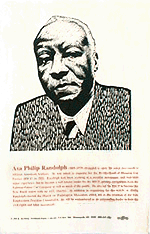 The Northland Poster Collective participates in this aspect of social (particularly workplace) struggles on three levels. Working with organizers and rank and filers we help them to identify and redefine the workplace narrative. To effectively organize, it makes a difference whether workers see themselves as part of a big, happy family; as engaged in a David vs. Goliath struggle; as rugged individuals who must each make their own way; as a community of interest in an exploitative environment, etc. Art, humor, and creative tactics can create a receptive atmosphere organizing and leadership development.
Telling untold (or miss-told) stories that can suggest avenues for action. Even when figures or events from social struggles are integrated into mainstream teaching they are presented in ways that emphasize individual heroics and chance. Our classroom posters focus on the collective action, planning, and community connection that offer a more reliable roadmap for creating change. By our choices of what stories to depict we help to challenge widely held notions about who is an actor in history.
Posterfolio sets help to bring more depth of knowledge (and curiosity) about events that people may know of only superficially. Posters that challenge deeply held assumptions. Less immediate in their impact, these may illustrate word definitions or the histories of everyday items, foods, etc. Seemingly innocuous, these posters contain layers of social history and suggest connections to other peoples that are absent from mainstream and commercial culture.
Making use of history as a lever for real change requires strategies for its dissemination. Our approach has been to use our relationships with schoolteachers, unions, and community organizations to distribute the work that we produce. These networks are also the source for information on the needs of the people at the front. Organizing seeds have a hard time growing in hostile soil. Tending to the cultural soil of the workplace, community, and broader society is a long-term and essential element in any strategy for change.”
At Least the Trains Ran on Time
From snopes:
“One of the best ways to gain the support of the people you want to lead is to do something of benefit to them. Failing that, the next best thing is to convince them that you have done something of benefit to them, even though you really haven’t. So it was with Benito Mussolini and the Italian railway system.
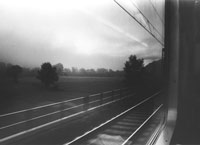 After the ‘march on Rome’ (which was itself a myth of fascist propaganda) on 28 October 1922 that resulted in King Vittorio Emanuele’s appointment of Benito Mussolini as prime minister and the accession to power of the fascists in Italy, Mussolini needed to convince the people of Italy that fascism was indeed a system that worked to their benefit. Thus was born the myth of fascist efficiency, with the train as its symbol. The word was spread that Mussolini had turned the dilapidated Italian railway system into one that was the envy of all Europe, featuring trains that were both dependable and punctual. In Mussolini’s Italy, all the trains ran on time.
Well, not quite. The Italian railway system had fallen into a rather sad state during World War I, and it did improve a good deal during the 1920s, but Mussolini was disingenuous in taking credit for the changes: much of the repair work had been performed before Mussolini and the fascists came to power in 1922. More importantly (to the claim at hand), those who actually lived in Italy during the Mussolini era have borne testimony that the Italian railway’s legendary adherence to timetables was far more myth than reality.
The myth of Mussolini’s punctual trains lives on, albeit with a different slant: rather than serving as a fictitious symbol of the benefits of fascism, it is now offered as a sardonic example that something good can result even from the worst of circumstances. As Montagu and Darling wrote:
‘Mussolini may have done many brutal and tyrannical things; he may have destroyed human freedom in Italy; he may have murdered and tortured citizens whose only crime was to oppose Mussolini; but “one had to admit” one thing about the Dictator: he “made the trains run on time.”’”
(Clip) Art for Activists
From Riniart.org:
 “For 20 years, Rini Templeton made drawings of activists in the United States, Mexico and Central America while she joined them in their meetings, demonstrations, picket lines and other actions for social justice. She called her bold black-and-white images ‘xerox art’ because activists and organizers could copy them easily for use in their banners, signs, leaflets, newsletters, even T-shirts, whenever needed.
Her drawings also included workers, women and children, celebrations, scenes of town and country, many images from daily life. In all her work you can feel a unity with grassroots people across national and racial lines. She almost never signed a drawing, out of typical modesty. As a result, her style is widely recognized but her name is not.
Two years after she died in Mexico in 1986, Rini’s work was published in a bilingual book in the U.S. (Real Comet Press, Seattle) and Mexico (Centro de Documentación Gráfica Rini Templeton). Entitled The Art of Rini Templeton: Where There is Life and Struggle/El Arte de Rini Templeton: Donde hay vida y lucha, the U.S. editorial coordinator was Elizabeth (Betita) Martinez. The Mexican team included 5 editors from the Punto Crítico magazine collective together with a production coordinator. All had worked with Rini extensively.
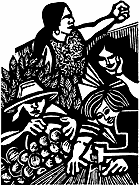 With the book out of print, it was decided to continue making her work available through this web-site. Rini’s sister, Lynne Brickley, made that possible with generous support.
You will find 600 drawings here, organized by theme, with brief texts in English explaining the story behind each set of drawings. There is also a short biography about Rini. Photos of her sculptures, done before she switched to graphic work, are not included here nor are the many reminiscences of Rini written by friends and co-workers for the book.
In the spirit of Rini Templeton’s life and work, activists serving causes that Rini would have supported are invited to use drawings freely in their leaflets, newsletters, banners and picket signs or for similar non-commercial purposes. Those wishing to use drawings in the production of an item for sale, such as a book, should write to the Rini Templeton Memorial Fund, c/o Elizabeth Martinez, 3545 24th Street, San Francisco, CA 94110. A reasonable fee will be asked, to help maintain this web-site.”
Viva Rini.
Olive Branch
 “In Israel, a forest of 6 million trees is being planted in the Judean hills between Jerusalem and Tel Aviv, in the words of B’nai B’rith, ‘as a living memorial to the six million Jews who perished in the Holocaust.’ Begun in 1954, this planting clearly takes on several layers of practical and symbolic meaning in Israel: it remembers both the martyrs of Nazi genocide and a return to life itself as cultivated in the founding of the State. Rather than remembering the victims in the emblems of destruction left behind by the Nazis, thereby succumbing to the Nazi cult of death, these trees recall both the lives lost and the affirmation of life itself as the surest memorial antidote to murder. It was also with this traditional veneration of life in mind, as symbolized in Jewish tradition by the Etz Chaim (tree of life), that Yad Vashem has planted a tree to remember and to name every single Gentile who rescued a Jew during World War II.” [source]
......
“Israel’s Defence Ministry is investigating reports that Palestinian olive trees uprooted to make way for a security fence are being sold illegally to rich Israelis and town councils, sometimes for thousands of pounds each.
The illegal trade in olive trees has flourished as Israeli contractors, supported by armed guards, clear Palestinian agricultural land where an 80-mile electronic fence is being built to seal off the West Bank.
Thousands of olive trees have been dug up to make way for the 150-ft wide barrier and security zone. Its route usually passes inside Palestinian territory, not along the old pre-1967 border, and thousands of Palestinian farmers say their livelihood is being taken away.
Sale of the olive trees emerged after the owner of a contracting company offered two reporters from a popular Israeli newspaper, Yedioth Ahronoth, 100 large olive trees for £150 each.
The reporters found one enormous tree, said to be 600 years old, on sale at an Israeli plant nursery for £3,500. They said the trade was conducted with the complicity of an official in the civil administration, the Israeli military government in the occupied territories....
Olives are the lifeblood of Palestinian agriculture, almost the only crop which grows on the stony hillsides of the West Bank without irrigation. Most Palestinians are unemployed after two years of violence and their staple diet is bread and olive oil.
About 11,000 Palestinian farmers will lose all or some of their land holdings to the fence. Sharif Omar, from the village of Jayous, near the Israeli town of Kochav Yair, said: ‘I have lost almost everything. I have lost 2,700 fruit and olive trees. And 44 of 50 acres I own have been confiscated for the fence.’
His village lost seven wells, 15,000 olive trees and 50,000 citrus and other fruit trees. ‘This area is the agricultural store for the West Bank. They are destroying us,’ he said.” [source]
No Man’s Land, International Park
From the Chicago Tribune, July 26, 2003:
Greening of the Iron Curtain
Gorbachev backs proposal to make border a preserve
“Mikhail Gorbachev, who as Soviet leader presided over the troops and tanks that guarded the Iron Curtain, now wants a nature reserve along the full length of the former Cold War border, from Finland to the Adriatic.
German and other European environmental groups have devised a plan to create nature parks out of the no man’s land that separated the Soviet bloc from the West.
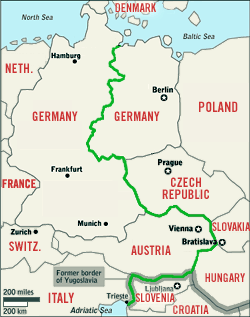 Kept forcibly free of people during more than 40 years of the Cold War, the border between Eastern and Western Europe became a refuge for plants and animals. Construction in the region now threatens these unintentional but important nature reserves, environmentalists fear.
‘Ecology isn’t something we can only leave to politicians,’ Gorbachev, who is president of the environmental organization Green Cross International, said when lending his support to the project at a recent conference in Bonn, Germany.
Although the idea of making parks along former Cold War borders has been around since the fall of the Berlin Wall in 1989, the conference was the first time that representatives of all the border countries had met to discuss the feasibility of having parkland run the length of what was the Iron Curtain.
Plans for the park are furthest along in Germany, where the border between East and West Germany once stretched for 870 miles. A recent study found that 85 percent of the land is still undeveloped enough to be included in a national park.
Plans were delayed while courts determined the status of the land, but most claims are now settled, and the German Finance Ministry recently announced it might be able to donate the 65 percent of former border land still in government possession.
Environmentalists emphasize that the reserve would not simply be the area it covered or the number of endangered species it contained but also that it would link many groups of organisms, known as biotopes, in the longest continuous stretch of undeveloped land left in Central Europe.
In the other former border countries, plans for a park are in only their early phases. The most likely route would be around the eastern half of Austria to the Adriatic, while another area would encompass Albania, whose border with Yugoslavia was always heavily guarded, and would then pass along the northern border of Greece.
Several speakers at the conference observed that Gorbachev — who could have rolled back Eastern Europe’s anti-Communist revolutions by force as his predecessors did — was on hand and had, in effect, made the border park possible.
Steffen Flath, the environment minister of what is now the German state of Saxony, once part of Communist East Germany, turned to Mr. Gorbachev and said, ‘I remember July 1989 when things were starting to bubble, and our government said, “Send us tanks,” and you, Mr. Gorbachev, you didn’t send those tanks.’
With the congratulatory words about vanishing borders in central Europe, however, some of those who follow events in this part of the world feared that events farther east were being ignored. Tamas Marghescu, European director of the World Conservation Union, said nervous states about to join the European Union were creating new divides. He cited what he said was a new impenetrable fence along the border between Poland and Belarus, which he said split an important park that straddles the border. ‘It’s the new Iron Curtain,’ he said.”
The Thayatal National Park, in Austria, and the Podyji National Park in the Czech Republic already exist along the river known in Austria as the Thaya, and in Czech as the Dyje, a former boundary of the Iron Curtain. [more]
via Planetizen
Toppling
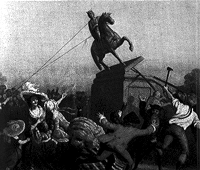 King George III
|
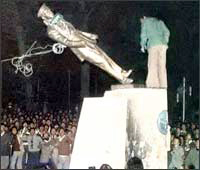 The Shah of Iran
|
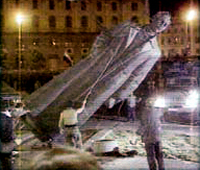
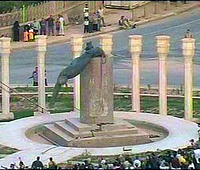
Unable to anticipate a clear surrender by the Iraqi government, on April 4 the Bush administration announced it’s vision of a “rolling victory,” “a strategy to declare victory in Iraq even if Saddam Hussein or key lieutenants remain at large and fighting continues in parts of the country.” Days later, the media run images of a statue of Hussein being toppled by U.S. marines and jubilant Iraqi’s.
...
A week later, protestors in San Francisco stage their own toppling of their own. A popular protest mimicking the Marines mimicking a popular protest, the protestors pull down a makeshift statue of President Bush in the style of Saddam Hussein’s.
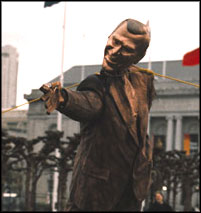
...
And a week after that, protestors in South Korea topple a cardboard cutout of a statue of Kim Il-Sung.
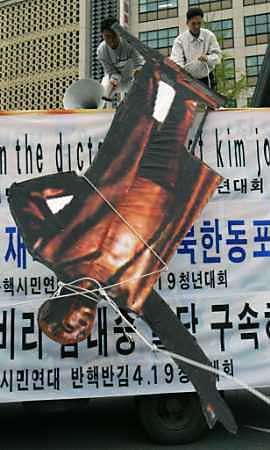
...
Update: On July 3, 2004 the Los Angeles Times confirmed that it was Army psy-ops that toppled the statue of Saddam Hussein, not the Iraqi civilians shown on television.
SILENCE = DEATH
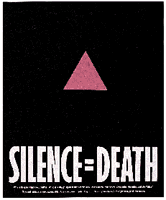 From the Encyclopedia of AIDS:
“The pink triangle was established as a pro-gay symbol by activists in the United States during the 1970s. Its precedent lay in World War II, when known homosexuals in Nazi concentration camps were forced to wear inverted pink triangle badges as identifiers, much in the same manner that Jews were forced to wear the yellow Star of David. Wearers of the pink triangle were considered at the bottom of the camp social system and subjected to particularly harsh maltreatment and degradation. Thus, the appropriation of the symbol of the pink triangle, usually turned upright rather than inverted, was a conscious attempt to transform a symbol of humiliation into one of solidarity and resistance. By the outset of the AIDS epidemic, it was well-entrenched as a symbol of gay pride and liberation.
In 1987, six gay activists in New York formed the Silence = Death Project and began plastering posters around the city featuring a pink triangle on a black background stating simply ‘SILENCE = DEATH.’ In its manifesto, the Silence = Death Project drew parallels between the Nazi period and the AIDS crisis, declaring that ‘silence about the oppression and annihilation of gay people, then and now, must be broken as a matter of our survival.’ The slogan thus protested both taboos around discussion of safer sex and the unwillingness of some to resist societal injustice and governmental indifference. The six men who created the project later joined the protest group ACT UP and offered the logo to the group, with which it remains closely identified.
Since its introduction, the ‘SILENCE = DEATH’ logo has appeared in a variety of manifestations, including in neon as part of an art display and on a widely worn button. It was also the forerunner of a range of parallel slogans such as ‘ACTION = LIFE’ and ‘IGNORANCE = FEAR’ and an entire genre of protest graphics, most notably including a bloodstained hand on a poster proclaiming that ‘the government has blood on its hands.’ Owing in part to its increasing identification with AIDS, the pink triangle was supplanted in the early 1990s by the rainbow as the dominant image of ‘gay pride.’ By force of analogy, however, the rainbow itself has, in some countries, become an image associated with AIDS.”
via ACT UP NY:
“There was also the SILENCE=DEATH Project, which was a group of men who had started meeting a year and half before [ACT UP was started], including Avram Finklestein, Oliver Smith, and Chris Lione. They were a whole group of men who needed to talk to each other and others about what the fuck were they going to do, being gay men in the age of AIDS?! Several of them were designers of various sorts—graphic designers—and they ended up deciding that they had to start doing wheat-pasting on the streets, to get the message out to people: ‘Why aren’t you doing something?’ So they created the SILENCE=DEATH logo well before ACT UP ever existed, and they made posters before ACT UP ever existed, and the posters at the bottom said something like, ‘What’s really happening in Washington? What’s happening with Reagan and Bush and the Food and Drug Administration?’ It ended with this statement: ‘Turn anger, fear, grief into action.’ Several of these graphic designers were at that first evening that Larry spoke.”
Big ’up to v-2.

