



memory
American Graffiti
In January 1991, George Lakoff published Metaphor and War: The Metaphor System Used to Justify War in the Gulf. He showed the discourse of war as ‘a panorama of metaphor,’ documenting, for instance, the state-as-person metaphor “engaging in social relations within a world community.” It’s health is economic health. It’s well-being is wealth. And its strength is military strength.
“War in this metaphor is a fight between two people, a form of hand-to-hand combat. Thus, the US sought to ‘push Iraq back out of Kuwait’ or ‘deal the enemy a heavy blow,’ or ‘deliver a knockout punch.’ A just war is thus a form of combat for the purpose of settling moral accounts....
The fairy tale has an asymmetry built into it. The hero is moral and courageous, while the villain is amoral and vicious. The hero is rational, but though the villain may be cunning and calculating, he cannot be reasoned with. Heroes thus cannot negotiate with villains; they must defeat them. The enemy-as-demon metaphor arises as a consequence of the fact that we understand what a just war is in terms of this fairy tale.
The most natural way to justify a war on moral grounds is to fit this fairy tale structure to a given situation. This is done by metaphorical definition, that is, by answering the questions: Who is the victim? Who is the villain? Who is the hero? What is the crime? What counts as victory? Each set of answers provides a different filled-out scenario.”
There is, of course, no room in these stories for the horror of war or the possibility of popular dissent.
In March 2003, on the eve of the second invasion, Lakoff published Metaphor and War, Again, charting again how the state-as-person continued to circulate. Added to this is the Rescue Scenario in which W. saves the Iraqi people and Saddam’s neighbors, whom he is “threatening.”
While Lakoff shows how metaphors help form conceptual frames that explain and justify military action, Yusuf Progler shows how these are rendered literal in blood and steel — inscribed onto the machinery itself.
From January 1999, Racist and degrading graffiti rooted in America's military culture:
During the last hours of ‘Operation Desert Fox,’ the murderous Anglo-American pre-Ramadan assault on the Muslim population of Iraq, the Associated Press broadcast a photograph of a US Navy missile ‘festooned with disparaging graffiti.’ Subsequent news reports mentioned one of the ‘several inscriptions’ scrawled on the missile: ‘Here’s a Ramadan present from Chad Rickenberg.’
Almost immediately, the offensive graffiti was strategically denounced by Pentagon officials as a ‘rare exception.’ In a statement released to the press, the Pentagon stressed that the graffiti ‘does not reflect American policy’ toward Muslims, adding that the US appreciates the ‘important contributions of Muslim-Americans to the US military.’ But despite the official denial, and though it received no further media attention, the incident is symptomatic of a long-standing legacy.
Aside from the reality that ‘American policy’ toward Muslims has included bombing and starving Iraq into oblivion, letting Bosnians be murdered and raped by Serbian fascists, supporting Israeli aggression in Palestine and Lebanon, destabilizing Iran, and attacking Somalia, Sudan, and Afghanistan, the graffiti incident is instructive in a number of ways. For one thing, it provides a rare glimpse into American military culture....
One need only look to earlier instances for verification. During ‘Desert Storm,’ the 1991 precursor to Desert Fox, reporters discovered the Anglo-American tradition of scribbling messages on bombs. Graffiti of that war ranged from adolescent silliness, such as ‘Hi Mom’ and ‘Say Cheese,’ to a range of witty puns like ‘Seasons Beatings,’ to virulently racist and sexist remarks like ‘Mrs. Saddam’s sex toy’ or ‘a suppository for Saddam.’ While British airmen are known to write messages like, ‘Dear Saddam, have a shitty day, love from the RAF,’ Americans tend to write more sexualized graffiti, with one reporter noting ‘the most identifiably American’ graffiti includes phrases like ‘bend over Saddam.’
Sometimes, US airmen write messages in their own blood. Since all of the weapons are blown to smithereens, and since the graffiti is in English, it seems obvious that the pearls of wrath and wisdom are intended for the artists themselves, almost like an inside joke, which is occasionally made public by news reports....
There’s no doubt that Chad Rickenberg, who painted a Ramadan greeting on a bomb destined to destroy Iraqis, had heard stories of similar acts committed by his predecessors in 1991, when another generation painted its degrading graffiti on bombs also destined to kill Iraqis. The oral tradition in the military passes on its rites of passage, which become badges of honor and belonging.
But such attitudes and practices toward Muslims did not emerge with the recent aggressions against Iraq and Iran. The first American military adventure against the Muslim world was initiated by then president Thomas Jefferson in the early 19th century. Those valiant exploits led to the formation of the American Navy and Marines, and the creation of a racist and phantasmagoric folklore about Muslim ‘barbarians’ and their ‘harems,’ the former to be killed and the latter to be raped. After a bit more practice on Indians and Africans, American soldiers massacred ‘Moro’ Muslims in the Philippines, America’s ‘Indian territory’ of the 1890s. Today, a century later, America’s Indian territory is Iraq. And the legacy marches on.
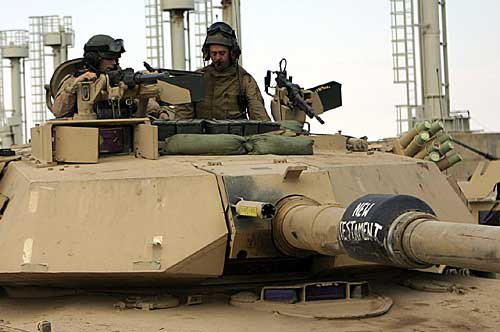
Indeed, this is made quite clear in this May 5, 2055 photo published on the Marine Corps own Web site. It is a photo of a U.S. tank in Iraq dubbed the ‘New Testament.’ Not only is it written across the barrel beneath the bowed head of the operator, it is highlighted in the caption:
“Haditha Dam, Al Anbar, Iraq - The ‘New Testament’ a tank with 4th Tank Co., 1st Tank battalion attached to 3/25 prepares to lead the way during a recent mission. Photo by: Cpl. Ken Melton.”
See also: Bombing Iraq, on the functions of Iraqi graffiti.
 25 May 2005 |
 Rock Around the Clock
In Phoenix, I stop for a burger with the family at the “Five and Diner.” The food is decent, but the decor is overwhelming — the place is a fully decked out in 1950’s retro style.
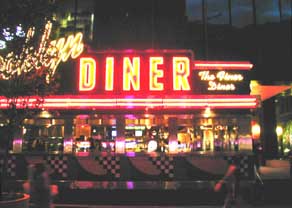 Why the association of diners with a certain kind of 1950’s art deco style? You know, the glass block and formica, checkered vinyl floor, those aluminum stools and that jukebox full of upbeat, happy rock songs (with no swear words), walls decked out with posters of Elvis, James Dean, Marilyn, and Coca-Cola...
Was it the new interstate highway system and manufacturing trends that put consumers on the road and brought machine-age styling to the lunch counter?
“It was a simpler time,” someone says. What, because post-war economic boom made such a happy middle-class? Or because G.I. bill paid your father’s college tuition and subsidized his mortgage? Was it all the white, middle-class families on TV? Or because it was before the end of segregation? Gay rights? The second wave of feminism? In fairness, though, as a kid maybe you were simpler.
But the Five and Diner is not some carefully preserved historic artifact. It is a fully contemporary invention, invested heavily in the myth of “the 50’s.” In fact, those “traditional family values” are a rather contemporary idea.
Art deco trappings and its Googie spawn were once signposts towards streamlined, technology-serviced future. The former was particularly embraced by European fascist states, the latter by an American suburban capitalism.
Now, both styles seem firmly lodged in the past. But they have not lost their utopian flavor — the futurism has been displaced by nostalgia.
In the U.S., at least, it’s become the visual, aesthetic, and user experience version of “comfort food.”
And adopted by the backlash.
The Revloution Begins in Kyrgyzstan
Protestors are occupying government buildings, have taken over an airport, and set fire to a police station.
Troubles
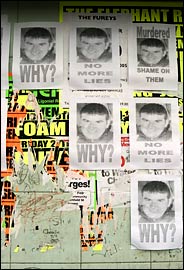 On the topic of posters and terrorism is this piece that ran in the NY Times two days ago about a growing backlash among Catholics to the violence of the Irish Republican Army.
Five sisters are defying intimidation, calling for justice for the murder of their brother and “what is widely seen as a subsequent I.R.A. cover-up.”
As part of the effort, they are posting graphics in the street, both a rallying cry and public defiance of a sector of the community who would silence dissent in the name of the cause.
“Many Catholics in the McCartneys’ neighborhood, a battle-scarred area called the Short Strand, have responded with surprising solidarity.
On the day of the funeral for Mr. McCartney, a popular 33-year-old fork lift operator with two young sons, a thousand people turned up. Graffiti denouncing the I.R.A. popped up on walls, a first in a republican neighborhood; the markings were quickly erased, but quickly reappeared. Small photocopied posters with Mr. McCartney’s photograph appeared on shop windows. ‘No More Lies,’ one said. ‘Shame on Them,’ said another.
Last Sunday, the women held a rally in the neighborhood. Hundreds showed up, including politicians, and several speakers expressed outrage. The sisters held placards that read, ‘Murdered - Who’s Next?’
‘If these men walk free from this, then everyone in Ireland should fear the consequences,’ Paula McCartney, 40, a Queen’s University student, told the crowd, according to news reports. ‘Justice must be done.’”
It is a kind of grassroots resistance to the established resistance, adding further stigma to the violent tactics — from the constituency such tactics are theoretically supposed to benefit.
Still, one has to wonder about the sudden interest of the NY Times in such resistance. The Times is so rarely sympathetic to such activities by left-wing groups. Is it simply the hypocrisy of a righteous group acting less than righteously? Or there another agenda at work? While the I.R.A. may indeed have turned to thuggery (they wouldn’t be the first armed resistance to do so) I suspect a kind of arrogant Statism at play, the sisters provide a convenient proxy to bash those pesky agitators.
Celebrate People’s History
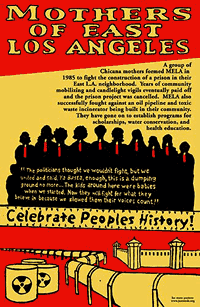 The Celebrate People’s History poster series is a series of linocut and silkscreen prints on important moments in ‘people’s history:’
“These are events, groups, and individuals that we should celebrate because of their importance in the struggle for social justice and freedom, but are instead buried or erased by dominant history. Posters celebrate important acts of resistance, those who fought tirelessly for justice and truth, and the days on which we can claim victories for the forces of freedom. In the past 5 years over a dozen posters have been produced on a variety of subjects, from the Battle of Homestead to Fred Hampton, Malcolm X to Jane, an underground abortion collective.”
The posters appear in storefront windows, homes, and classrooms, and are wheatpasted by street teams to public spaces around the U.S.
Nearly seven years old, the project has also created a loose network of artists interested in creating radical public art and showcasing the work of unknown artists who want to create art that is functional, carries a social message, “and doesn’t get buried at the bottom of the heap of the capitalist ‘art world.’”
Images are visible here and on this brief interview with Josh MacPhee one of the organizers.
The project is always looking for new artists to design posters, so if you or anyone you know might be interested, just get in touch.
See also this post on the Northland Poster Collective Posterfolio.
What Color are You?
Those political symbols, even for specific elections, don’t just rally the base — they reach far beyond their borders.
For instance, elections in Kyrgyzstan take place next month.
Kyrgyz Leaders Eye Ukraine Nervously, December 21, 2004:
“Speaking at a conference on democracy in Bishkek, [President Akayev] warned that no ‘colour’ revolutions would be permitted in Kyrgyzstan, referring to Georgia’s ‘rose revolution’ which brought down President Eduard Shevardnadze in November 2003, and the recent post-election turmoil in Ukraine, where Yuschenko supporters wore distinctive orange scarves.”
“Kyrgyz opposition responds to President Akayev’s warning of possible coup,” December 22, 2004, BBC Monitoring Central Asia:
“The united opposition in Kyrgyzstan denies the suggestion that it has ties to the West and does not believe that any revolutionary scenarios will be played out during the parliamentary election campaign. The deputies representing opposition parties and movements in Kyrgyzstan’s parliament even issued a lengthy statement to assure the public that they ‘do not applaud the events occurring in Ukraine’ and that they are not planning to organize a ‘tulip revolution’ in Kyrgyzstan, because ‘it could cause disparities in the country’s system of government’. Furthermore, the statement underscored the opposition’s intention to prevent any kind of outside intervention in the electoral process in Kyrgyzstan.”
KYRGYZINFO, January 13, 2005:
“President of Kyrgyzstan Askar Akaev urged the population of the republic to oppose the provocateurs and exporters of ‘velvet revolutions’. This was stated in his address to the people, to the parliament, to the government, to representatives of international organizations, to accredited diplomats and journalists.”
“Kyrgyz youth movement says no to ‘export of revolutions,’” January 18, 2005, BBC Monitoring Central Asia:
“The leader of the KelKel youth civil movement said: ‘Lemon is our symbol. We have chosen the lemon colour. We are against a party of the orange orange [Russian: oranzhevyy apelsin]. We are against the export of revolutions from abroad. We want to build our house on our own. We want to live in a sovereign and independent state.’”
Could this be the end of the one-color state?
Starring John Kerry
Back in January 2003, nearly a year before the Democratic primaries, I posted a blog entry on The Committee to Help Unsell the War, a mobilization of students and advertising agencies against the Vietnam War.
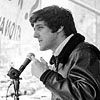 Without my realizing it, that representative I mentioned from Vietnam Veterans Against the War who “discussed war crimes and problems veterans faced” was, in fact, John Kerry.
Milton Rosenberg, the professor of social psychology from the University of Chicago cited in the piece as “perhaps the most influential speaker,” emails:
“I was ego-surfing yesterday as I tried out the new microsoft search engine---and I came upon your longish quotation from a book that deals with the ‘Unsell the War’ and the organizing meeting that was held at Yale....
Of additional--and rather risible--interest is the reference to ‘a representative of Vietnam Veterans Against the War.’ That was John Kerry!!-- of whom I had never before heard. He stood out for his skeletal frame, his hair and his plummy brahminical accent--but not particularly for his rhetorical skill.
I too was asked to judge the resulting TV spots---but in an advisory role rather than as one of official screening panel.”
Rosenberg notes it was his book that got him invited and on which he spoke. He co-authored of Vietnam and the Silent Majority: The Dove’s Guide in 1970:
“Our book was a quick effort designed to analyze the available public opinion data and to show that the ‘silent majority’ was silent in its opposition (rather than its support, as Nixon contended) of the Vietnam war. It also offered a design for how to propagandize for early withdrawal from the war, a policy strongly urged by the Committee for a Sane Nuclear Policy on whose National Board I served at the time.”
RNC Recap
A friend has graciously permitted me to post his recap of RNC week:
“My dears Al and Mrs. S., ever the social workers, were eager to join me on Friday night’s Critical Mass bike ride. At Union Square, several of the farm vendors decided, perhaps in leu of the overwhelming crowds, to give away their end-of-day produce and baked goods. So, as the numbers of cyclists grew exponentially, we enjoyed watching the kids, who looked more at home on an Earth First commune than in front of Republic, as they heartily chomped on the raw sweet corn and warily sniffed the fresh muffins for signs of dairy.
As we peddled off (reminding me of the gnarled-metal cycle-density of Shanghai biking), we received applause from plenty of 14th street bystanders. By the time we got to Houston, the sun had set, and the bike ranks had ribboned along Broadway so we had to be wary of cabs darting past and around us. But as we began to again amass up Sixth Ave, tensions (which i’ve known too well as an ACT UP marshall for so many years) from snarled and snarling motorists inconvenienced by the rally grew ugly. Clearly, no police arrangements had been made, making this a potentially dangerous action, further worsened by inexperienced young cyclists who were aggressively flinging their bikes (and only pair of legs) into the paths of vehicles. Enraged drivers bolted out of their vehicles, one block after another, and we elders intervened in several separate potentially violent confrontations. Fortunately serious violence was assuaged, but not without seeing the cyclists, in a number of incidents, being uglier and more aggressive than the SUV drivers. By the time we got to 23rd street, the random arrests had begun. The event had successfully vilified cyclists to many drivers and police
I missed NOW’s CODE RED March over the Bridge — the photos of my beloveds, the CHURCH LADIES FOR CHOICE looked great. I made it to City Hall for the end of the Rally; the most stunning rally sound-bite take-away for me was learning that 40 million women who were eligible to vote in 2000 didn’t.
As the NYC Sanitation trucks moved in, i could not fathom why the organizers didn’t insist that the many, many thousands of people at the rally take the many thousands of expensive printed protests signs, fold them into their bags and make damn sure they were visible up all over town the entire week, and in windows through November.
Saturday evening brought thousands of bells and their owners to “the socket” and the utter bewilderment of puzzled Ground Zero pilgrim/tourists and vendors [photos]. The Calatrava “temporary” entrance to the PATH trains became a pagoda for the bells, where volunteers gave us programs that looked like LIRR train schedules. intending to ‘orchestrate’ the event, with the occasional hissing of Buddhists who were angered by gentle nearby conversation, created a soundscape only defiled later by a guy who worked the city the whole week with a big Freddy Phelps-like scroll of a sign quoting some scripture confirming why we must vote for Bush. Upon his arrival, the press was no longer interested in Pauline Oliveros’s ambitious memorial: the jingle bells, Tibetan bells chimes, and at least one industrial lampshade being thumped like a muffled gong.
The THOUSAND COFFINS affinity group at the big march was in need of help. So we helped, finishing a few pre-fab die-cut cardboard coffins, draping them with flags (black bunting for unknown soldiers), then committing to the intense heat of the next six hours. It doesn’t take much crowd-estimation expertise to conclude that a mere 100,000 people would have taken over six hours to march the 42 block route. I yearned for a rally, chock-full of speakers (many with issues that, while unrelated to the war, would still not be even voiced if the Republicans had their way), But the gigantic rally was amazing, in it’s disjointed groups; and you couldn’t help but marvel at the thoughtully engineered, underestimated march attendee counts from the press ‘n’ state.. But silently walking the coffins was a meditative way to participate. No Central Park picnic for our procession, we got to Union Square around 6 p.m., quietly dissembling the coffins and folding the flags, looking more saddened than defiant.
Although looking out my window Tuesday night I couldn’t tell if anyone else intentionally illuminated their windows, I struggled to sleep under a “What’s My Line” airline sleep-visor in my brilliantly illuminated bedroom. I had dutifully followed Milton Glaser’s request and put a ‘light’ in my window. Having recently acquired one of the ubiquitous rainbow WE THE PEOPLE flags, I taped it up in my window over Broadway, with my art projector aimed at it all night : Spent Nuclear Fuel Rods for Peace...
Throughout the week, every time i ventured outside, i wore a 8.5” x 11” repro of the great Plaza Hotel TRUTH -> <- BUSH banner mounted to foamcore and gold cord around my neck. I tended to avoid eye contact and wore a tie most days. Many people approached me all week, as inspired by the banner as i was.
Due to a work commitment, on Thursday, I was on the uptown (2) train pretty-much directly under Madison Square Garden while W was speaking: after all the overtime, there was zero security on the subway or platforms; people on the train laughing — having clearly just heard or participated in shouting “FUGEDDABOUTIT!” as Al Franken had proposed.
Friday morning, off to the GM building plaza, with an enlarged poster of the great Plaza TRUTH -> <- BUSH banner. CNN was interviewing what appeared to be high-school boys in tee shirts with “one-eyed pirates” for a liquor company. As i was manhandled off the property, they kept growling “No politics HERE, No politics HERE.” And I foolishly shrieked about how having young kids advertising booze was Highly Political.
During the week, the event that got the least press was the media march from the CBS building to FOX [photos]. I printed out a long tall (conventioneer’s) sign that read BAN 527’s / BEGIN WITH FOX. People laughed, but it was too cryptic to make the evening news. In fact, the only press i saw for the event was of Miss Understood and Lady Bunny who stormed the rally in Grand Drag... good for them! Motherfuckers.
Then, in a blink of the shutter, the RNC circus left town.
Jamie Leo, reporting.”
Call to Arms!
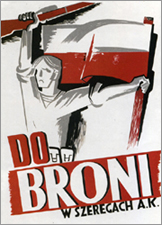
Rene Wanner has maintained his Poster Page on the Web continuously since August 21, 1997. In May, he started a blog. Yesterday, he noted:
“[August 1] is the 60th anniversary of the Warsaw Uprising against the German occupation in World War II, during which more than 250,000 people were killed and the city was largely destroyed. Some posters made by the insurgents have survived, among them the famous “Call to Arms!” (Do Broni!) by Mieczyslaw Jurgielewicz. A year before, in 1943, the Warsaw Ghetto Uprising which also failed, extinguished the lives of the jewish population of Warsaw, which was about 375,000 before the war.”
...
Also on August 1, 1944, four thousand Roma were gassed and incinerated at Auschwitz-Birkenau. By the end of the war, between 70% and 80% of the Romani population had been annihilated by Nazis. In Romani it is called “the Devouring.”
After the war, no Roma were called to testify at the Nuremberg Trials, and no one came forth to testify on their behalf. No war crimes reparations have been paid to the Roma as a people. And no posters of resistance are known. [source]
Instrumental
Following Brian’s travels through Morocco, I ran into this interesting bit from his visit to Marrakesh that relates to exhibition design:
“Captions [in the Museum of Moroccan Art] were available in both French and Arabic. I originally thought I would be able to understand almost everything from my knowledge of the two languages; however, I quickly discovered a flaw in this plan: The explanations were often different.
For example, in discussing a particular musical style, the French caption talked about how it was derived from Greek forms, while the Arabic explained it as going back to the Abbasid court at Baghdad. Both of these could be true - the people at the Abbasid court could have developed it from Greek forms, but the targeted cultural bias of the information presented is an interested insight into the way the tourist industry operates. I once read an article about how tour guides in Israel change what they highlight and the style of their presentation based on the group they are guiding. The Museum of Moroccan Art in Marrakesh seems to unabashedly post written evidence of this as Arab and European tourists wander through having the information presented in a context which affirms their own culture’s past.”
Brian’s interpretation notwithstanding, he’s on to something: given Morocco’s privileged geography between continents and at the nexus of so many trade routes among regions and empires, I suspect its traditional forms were influenced by very many cultural traditions, long before the histories were spun so neatly into “East” and “West.”
Given that the curators are clearly aware of this, it’s all the more interesting that they choose to present the two distinct narratives rather than a more nuanced account of cultural exchange.

