



memory
Workers of the World Play Ball, 2
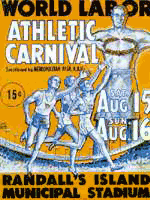 With regards to this post, reader ryan sent me this bit from NYU’s Robert F. Wagner Labor Archives about another labor-driven counter-olympics event. This one hosted by the Jewish Labor Committee in New York City as part of its anti-Nazi campaign:
“When the American Olympics Committee declined to heed widespread protests against United States participation in the Berlin Olympics of 1936, the [Jewish Labor Committee] held a World Labor Athletic Carnival (also known as the Counter-Olympics) at Randall’s Island in New York City during August 1936. Dozens of teams representing New York union locals competed, and the main events featured outstanding amateur athletes from across the country. Governor Herbert Lehman presented the prizes. The Carnival received extensive nationwide press coverage, and the JLC repeated the event in the summer of 1937.”
The site has a few images from the movement.
 16 February 2006 |
 Workers of the World Play Ball
The International Institute of Social History in The Netherlands has a brief text, a few posters, and a couple of photos from the Labour Olympiads, an counterevent to the Olympics between World War I and II:
“In the twenties, the Olympic games got their counterpart within the labour movement. Labour Olympiads took place in Frankfurt, Vienna and Antwerp. Workers played soccer, practised gymnastics and ran for world peace instead of the national honour.
As a result of the struggle for the 8 hour working day, workers had time for sport. Already in the beginning of the 20th century workers participated in games with comrades in neighbouring countries. Massive labour sport unions were founded in Germany, Austria, Czechoslovakia, Belgium and France. They strove to educate workers both physically and spiritually.
The Labour Olympiads, organised by the Socialist Workers’ Sport International (SASI), fit well with these ideals. Against the normal Olympic games, marked as ‘a war between nations gained by sportive means’, stood the solidarity of comrades in sport. The labour sport unions disapproved of idols and records. At the labour games the anthem of the socialist international replaced the national anthem of the winning country. And only the red flag flew. Participation was more important than winning.”
Contextual Advertising, Redux
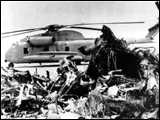 Reader Ravenmn writes:
“Your item about the bad ad placement in Germany reminds me of an experience I had as a typesetter at the Minnesota Daily, the student newspaper of the University of Minnesota. In April of 1980, nobody noticed that the Army Helicopter Pilot Training ROTC ad was running on the same page as the story of the failed helicopter rescue attempt Jimmy Carter sent to Iran during the hostage crisis, complete with photo of mangled helicopters in the desert. ROTC got a couple of free ads out of it, if I recall correctly.”
I found the photo on http://remember.gov, the Web site White House Commission on Remembrance, your official source for state-sponsored memory.
East Village Memorial
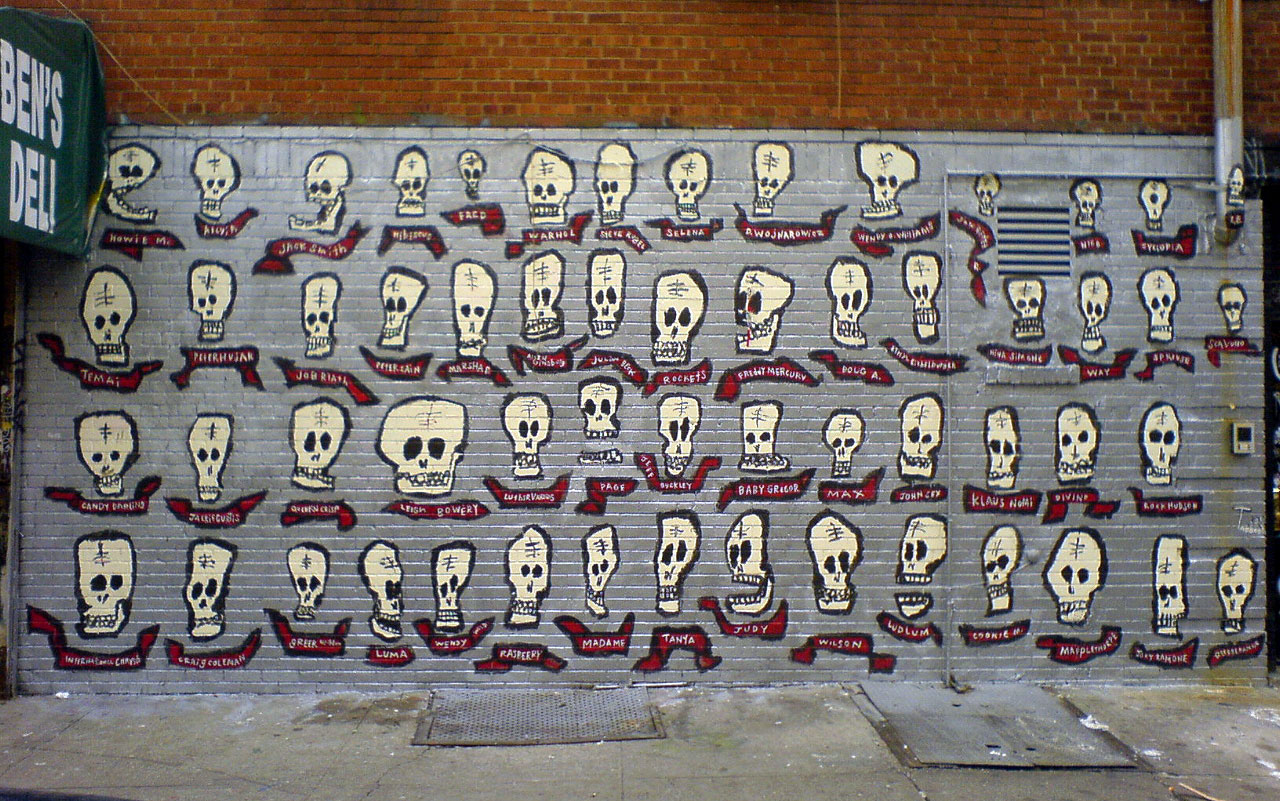
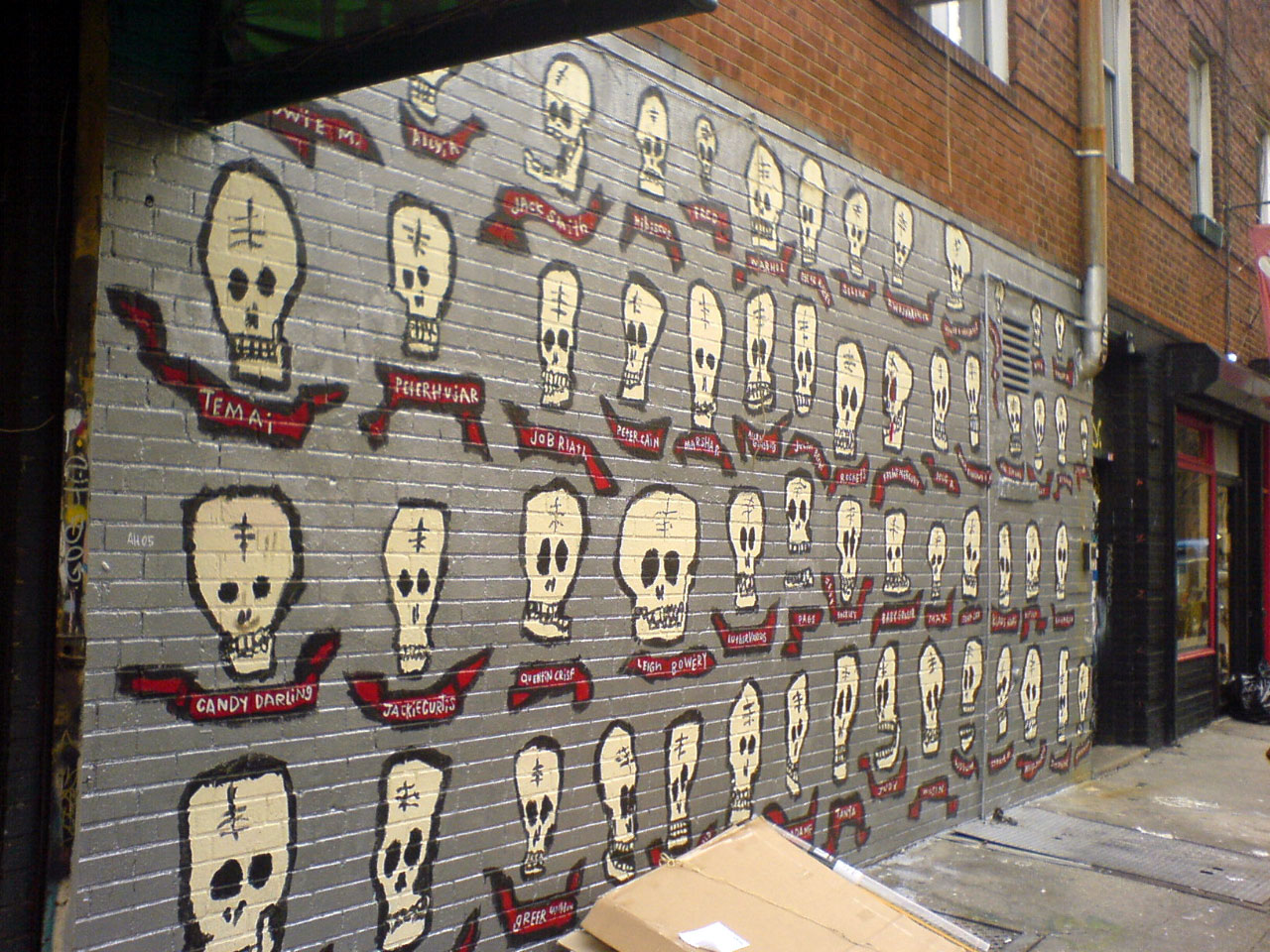
This memorial is painted on the side of Mamma’s Food Shop on 6th street and Avenue C. Click the image above for a larger version. The mural is signed by Taboo!, an East Village drag queen. I couldn’t find much about her online except mention (and a photo) in this old Wigstock release.
The piece commemorates a mix of stars, artists, drag queens, and others. Some died of AIDS, others were East Village locals. Some names I recognize, others I do not. Members of a family quietly fading.
Up in Smoke
Back in November 2004, a portrait of a U.S. Marine in Iraq rapidly became an icon of weary, insouciant toughness and cool that so many love in their cinematic heros.
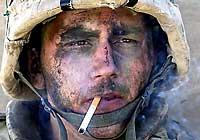 Patrick J. McDonnell wrote in the Los Angeles Times:
A smoke break creates icon of the war; now groupies seek out the weary Marine
“Miller is the young man whose gritty, war-hardened portrait, shot by Luis Sinco, a Los Angeles Times photographer, appeared Wednesday in more than 100 U.S. newspapers, including The Seattle Times. In the full-frame photo, taken after more than 12 hours of nearly nonstop deadly combat, Miller’s camouflage war paint is smudged. He sports a bloody nick on his nose. His helmet and chin strap frame a weary expression that seems to convey the timeless fatigue of battle. And there is the cigarette, of course, drooping from the right side of his mouth in a jaunty manner that Humphrey Bogart would have approved of. Wispy smoke drifts off to his left.
The image has quickly moved into the realm of the iconic.
More than 100 newspapers printed it, although it took the New York Post to sum it up in a front-page headline: ‘Marlboro Men Kick Butt in Fallujah.’ The fact that Miller’s name was not included in the caption material only seemed to enhance its punch....
The photo was taken on the afternoon after Charlie Company’s harrowing entry into Fallujah under intense enemy fire, in the cold and rain. Miller was on the roof of a home where he and his fellow First Platoon members had spent the day engaged in practically nonstop firefights, fending off snipers and attackers who rushed the building. No one had slept in more than 24 hours. All were physically and emotionally drained.”
See this previous post on Bag News Notes for further analysis of the Times article and photo.
See also Human Rights Watch‘s report on Charlie Company‘s earlier seige and occupation of Fallujah.
Today, however, we learn from Editor and Publisher that:
‘Marlboro Man’ in Iraq War Photo Suffers from PTSD
Back home, he got married in June, but on duty during the Hurricane Katrina relief effort, Miller suffered from symptoms of post-traumatic stress disorder (PTSD), and was granted an honorable discharge from the Marines in November....
Miller went into therapy, but knows he is not alone. ‘A lot of guys have had way worse incidents from being in Iraq,’ he said. ‘And I guess it just -- it troubled me due to the fact that their incidents may have been more severe, and they weren’t suffering from the same things I was. I just didn’t understand how it could affect me so dramatically and not affect some of these guys. But a lot of them deal with different ways.
‘The more and more I talk to [other guys], the more I found out there were a lot of Marines that are going through same or similar emotions. It’s tough to deal with. Being in Iraq is something no one wants to talk about.’”
Exeunt
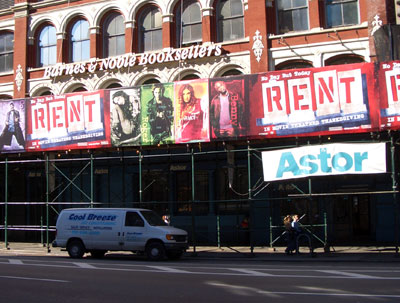
How bitter to see ads for RENT plastered on the Barnes & Noble at Astor Place. You know, the one across from the new glass tower of luxury condos atop the Chase Bank?
The summer I moved to NYC marked the third anniversary of the Tompkins Square Riot, captured obliquely in the play. Freshmen were warned not venture east of Avenue A after dark. Now you can’t get a table there without a reservation.
Gentrification, squatters, art, AIDS, drugs, poverty, homelessness, riots, gender bending, love and death in the East Village — now a major Hollywood motion picture. Coming soon to the East Village.
Rosa Parks
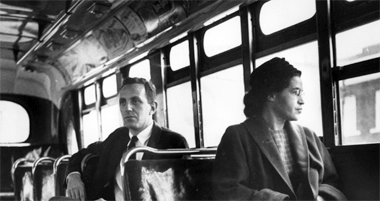
Lots of blogging and news today about the passing of Rosa Parks today at age 92. Google’s blog search shows well over 15,000 blog posts, so I’m not sure I have much to add. Still, I want to point to both her own words and the organizational context which seems absent from most versions of the story.
This morning Democracy Now today aired an interview with her from 1956, a year after the incident, and shortly before the end of the bus boycott. From it I learned a couple of things:
She was not actually at the front of the bus, but at the front of the ‘Negro section’ of the bus. The routine was that when the ‘white’ part was full, black passengers were expected to give up their seats and stand so that whites could sit.
She was not some young radical, but a full 43 when she refused to stand. Rev. King, on the other hand, was all of 26 that winter.
It was not just her civil disobedience and arrest, but the story of it that catalyzed the larger action. She was not the first to refuse her seat nor to be arrested for it, but the timing was right. Her arrest came just months after the lynching of Emmett Till. At the time, the Women’s Political Council was building a case to challenge Jim Crow laws. The organization had been working for ten years to fight the mistreatment of black bus riders.
Mrs. Parks had been involved with the organization and with the broader civil rights movement, in NAACP and with her church. She was helping prepare for a major NAACP youth conference at the time of her arrest. I suspect her involvement with these networks helped spread the word. The Women’s Council distributed 35,000 flyers urging blacks to boycott the buses on December 5, the day of Mrs. Parks’s trial.
In her own words:
“The driver said that if I refused to leave the seat, he would have to call the police. And I told him, ‘Just call the police.’ He then called the officers of the law. They came and placed me under arrest, violation of the segregation law of the City and State of Alabama Transportation. I didn’t think I was violating any. I felt that I was not being treated right, and that I had a right to retain the seat that I had taken as a passenger on the bus. The time had just come when I had been pushed as far as I could stand to be pushed, I suppose. They placed me under arrest. And I wasn't afraid. I don't know why I wasn’t, but I didn’t feel afraid. I had decided that I would have to know once and for all what rights I had as a human being and a citizen, even in Montgomery, Alabama....
And Monday morning, when the buses were out on the regular run, they remained empty. People were walking or getting rides in cars with people who would pick them up, as best they could. On Monday night, the mass meeting at the Hope Street Baptist Church had been called. And there were many thousand people there. They kept coming, and some people never did get in the church, there was so many.
I was not the only person who had been mistreated and humiliated. I have been refused entrance on the buses because I would not pay my fare at the front and go around to the rear door to enter. That was the custom if the bus was crowded up to the point where the white passengers would start occupying. I hadn’t thought that I would be the person to do this. It hadn’t occurred to me. Others had gone through the same experience, some even worse experience than mine, and they all felt that the time had come, that they should decide that we would have to stop supporting the bus company until we were given better service. And the first day of remaining off the bus had been so successful. It was organized, in that we wouldn’t ride the bus until our request had been granted.”
During the boycott Mrs. Parks was unable to find work in Montgomery — no one would hire her. She moved to Hampton, Virginia and ultimately to Detroit with her husband.
The photo above was taken while she sat on a bus in front of the Supreme Court in November 1956, awaiting the decision that would find segregation on transportation unconstitutional.
Rest in peace, Mrs. Parks.
Support Our Tropes, 2

It’s a funny thing to see all the flag waving conflated with the whole “support the troops” message today. I support the troops plenty, though not this stupid war. But then what exactly do the troops have to do with the fourth of July? I mean, today is Independence Day! The day we celebrate the American Revolution, when a plucky, unorganized group of armed radicals defeated the professional military of a foreign occupation. A victory for automony over empire! In Iraq, aren’t the U.S. troops a lot closer ye olde army of King George?
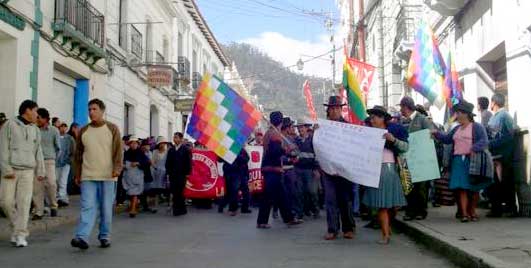
The Wiphala
The Wiphala (from the Aymara word meaning “flag”) is a square shaped flag consisting of forty-nine small squares in a seven by seven grid, in the colors of the rainbow graduating from the brightest to the palest.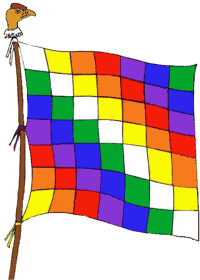
The flag is a symbol of the Aymara people, and recently, of the Aymara uprising in Bolivia. It has also become a symbol in the broader iconography of pro-indigenous movements in Ecuador, Peru, Bolivia, and Chile.
The origin of the design is uncertain. It is attributed the ancient Tiwanaku state. However, despite the indigenous aesthetic resonances of the unusual square pattern and multicolor geometry, it is most likely of modern origin. Although pre-Columbian towns of the Andes did not lack their own symbols (particularly those with a state tradition, like the Inca), the format of quadrilateral textile banner to wave in the wind is a tradition of the Old World.
Archaeological fragments from antiquity support the thesis that it may a “rescued” old symbol, as with the Chakana or Andean cross. It is possible that the modern origin of the Wiphala (without discarding the hypothesis of its Tiwanaku roots) is related to the design of modern flag of the Cusco (rectangular with seven horizontal strips with the colors of rainbow), which many claim to be a flag of the Incas.
Rainbow patterns were used in several symbols of the Tiwanaku state, but it is not documented in the form of a flag — while other formats of indigenous state symbols have been found.
 However, Aymara textile read as a symbol is not completely unheard of. In 1534, during the Spanish invasion and occupation of Cuzcu, the Spaniards found among the resistance a multitude of objects similar to the striped flag and and other iconography with the of seven colors of the rainbow. The Wiphala was banned, considered politically subversive by the governing elite.
The great explosion in the use of the Wiphala coincides with the rural mobilizations and indigenous movements in Bolivia in the 1970’s. It has since become a recognizable Amerindian symbol in the political struggles of the indigenous nations of the American continent. In Bolivia, the Wiphala is visible in all kinds of public demonstrations, political actions, and civil resistance by the Aymara and Quechua population.
Civic use of the Wiphala in the daily life of indigenous communities has also grown enormously. It has become an Andean custom to hoist the flag at social and cultural events, ceremonies, and celebrations.
Memory Virus
“The latest Sober variant is one of a relatively new type of ‘propaganda spam,’ meant to spread political messages rather than sell a product or service. Circulation of the worm coincides with ceremonies marking the 60th anniversary of the end of World War II in Europe and examples of subject lines it sends include ‘Dresden 1945’ and ‘Du wirst zum Sklaven gemacht!!!’ (‘You are made slaves!!!’).
We are updating our spam filter.”

