



resources
Free Stock Photography
Robin Good has pulled together a great list of free stock photo sites:
- FreeFoto
- ImageAfter/
- morgueFile
- Open Photo
- OurMedia/
- PDPhoto
- PixelPerfect Digital
- StockVault
- stock.xchng
- Yotophoto
Wikipedia also has a large list of public domain image resources.
Please note, the images on these sites have different licensing schemes and credit requirements, so read up before you use. For instance, Buzznet and Flickr are large photo sharing communities of personal photos. The use restrictions are unclear.
 9 April 2005 |
 Design Planning for Activists
A few places to start:
- Planning Your Next Conference (855KB PDF)
“This paper is intended to assist organizers in developing successful grassroots/community level conferences within 5 months. It is written from a designer’s perspective to help you complete your tasks for maximum impact and minimum stress.” - Failing By Design: Why Bad Ads Happen to Good Causes (1.9MB PDF)
On layout and messaging. - 14 ways to cut design and production costs (while increasing response)
How to work with print shops. - Public Relations Strategy and Media Relations Tips for Non-Profits and Advocacy Campaigns
An Introduction to Activism on the Internet
I’m collecting some principles, techniques, and examples of electronic advocacy into a brief introduction and overview of uses of the Internet for advocacy.
I’ve posted my draft online at http://backspace.com/action and am soliciting comments from the public.
If you’re interested, do check it out and let me know what you think. You can post comments directly to the site.
And do please circulate this Web address as you see fit.
Update February 16, 2004: I’ve revised the text, incorporated some of the feedback, and removed the DRAFT label.
Many thanks to everyone who commented. If I incorporated your comments, I added your name to the acknowledgments page.
The comments form will remain open a while longer.
Fashion Statement


OK, OK, OK.
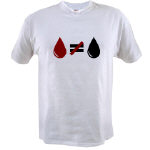
So, every time I show someone a graphic idea for a flyer or something they inevitably say, “You know, that would make a great T-shirt.”
Alright, then. I’ve created a few at CafePress. You can order them online at http://cafeshops.com/nornc
For sale: T-shirts, tank tops, posters, postcards, and stickers to welcome the Republicans in style.
Only three designs so far, but let me know what you think and I might make more.
Note, all prices shown are CafePress’s base prices. I’m not making any money here. I just want to get the word out.
---
And by the way, if you want to design some T-shirts yourself, CafePress makes it fairly easy. Basically, you upload a high resolution graphic through your Web browser to their Web site, select the product, and order it online. Voila! They handle the payment processing, printing, shipping, and customer service. You can put your design onto T-shirts, hoodies, lunch boxes, frisbees, postcards, and more. (See for instance, this lovely turntable mousepad I made.) Setting up a basic store online is free.
Paginate HTML from Word
 After ribbing David about open sourcing his content management system, I decided to put up myself. So here’s my first Free Software project: pagify is a perl script that takes the output of Microsoft Word’s “Save as Web Page...” and
- cleans out the cruft and proprietary XML gunk,
- splits the file into HTML pages wherever a Heading 1 style appears, and
- converts endnotes into footnotes on the appropriate pages.
(Clip) Art for Activists
From Riniart.org:
 “For 20 years, Rini Templeton made drawings of activists in the United States, Mexico and Central America while she joined them in their meetings, demonstrations, picket lines and other actions for social justice. She called her bold black-and-white images ‘xerox art’ because activists and organizers could copy them easily for use in their banners, signs, leaflets, newsletters, even T-shirts, whenever needed.
Her drawings also included workers, women and children, celebrations, scenes of town and country, many images from daily life. In all her work you can feel a unity with grassroots people across national and racial lines. She almost never signed a drawing, out of typical modesty. As a result, her style is widely recognized but her name is not.
Two years after she died in Mexico in 1986, Rini’s work was published in a bilingual book in the U.S. (Real Comet Press, Seattle) and Mexico (Centro de Documentación Gráfica Rini Templeton). Entitled The Art of Rini Templeton: Where There is Life and Struggle/El Arte de Rini Templeton: Donde hay vida y lucha, the U.S. editorial coordinator was Elizabeth (Betita) Martinez. The Mexican team included 5 editors from the Punto Crítico magazine collective together with a production coordinator. All had worked with Rini extensively.
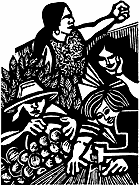 With the book out of print, it was decided to continue making her work available through this web-site. Rini’s sister, Lynne Brickley, made that possible with generous support.
You will find 600 drawings here, organized by theme, with brief texts in English explaining the story behind each set of drawings. There is also a short biography about Rini. Photos of her sculptures, done before she switched to graphic work, are not included here nor are the many reminiscences of Rini written by friends and co-workers for the book.
In the spirit of Rini Templeton’s life and work, activists serving causes that Rini would have supported are invited to use drawings freely in their leaflets, newsletters, banners and picket signs or for similar non-commercial purposes. Those wishing to use drawings in the production of an item for sale, such as a book, should write to the Rini Templeton Memorial Fund, c/o Elizabeth Martinez, 3545 24th Street, San Francisco, CA 94110. A reasonable fee will be asked, to help maintain this web-site.”
Viva Rini.
I Do Not Consent to this Search
Some pocket reference for troubled times:
 “Know Your Rights,” pamphlets and posters from the National Lawyer’s Guild on your rights of political protest intended to assist people who have already independently decided to engage in civil disobedience. Available in English, Spanish, Arabic, Farsi, Punjabi, and Portugeuse.
- “Know Your Rights: What to Do If You’re Stopped by the Police, the FBI, the INS or the Customs Service” is published by the ACLU in English, Arabic, Spanish, Punjabi, Hindi, Urdu, Farsi, and Somali.
- From the Just Law Collective, legal handbooks for protestors, legal observers, and those on trial for political protest.
- From the Asian American Legal Defense and Education Fund, a small pamphlet on your rights and “special registration” with the INS for men who live in the U.S., are not citizens, and are of North Korean, Indonesian, Bangladeshi and Pakistani origin. In English, Korean, Indonesian.
- At May Day Books I picked up a free copy of “Fight the Man and Get Away Safely,” street tactics and pointers on how to safely survive situations created by police violence and confrontation, once such a situation has occurred. The online version is less designed than the paper one, but the text is all there.
- From the Black Cross Health Collective, comes “First Aid for Radicals and Activists”, how to prepare, what to wear, what not to do, and notes on medical care if arrested or assaulted by police. Also check out their training guide for an introduction to health care at protests, and the gear list for a first aid kit for the streets.
If you know of other useful pamphlets on street tactics and the law, please .
Steal This Book
“Leaflets, posters, newsletters, pamphlets and other printed matter are important to any revolution. A printing workshop is a definite need in all communities, regardless of size. It can vary from a garage with a mimeograph machine to a mammoth operation complete with printing presses and fancy photo equipment. With less than a hundred dollars and some space, you can begin this vital service. It’ll take a while before you get into printing greenbacks, phony identification papers and credit cards like the big boys, but to walk a mile you must start with one step as Gutenberg once said.”
...
“Food conspiracies, bust trusts, people’s clinics and demonstrations are all part of the new Nation, but if asked to name the most important institution in our lives, one would have to say the underground newspaper. It keeps tuned 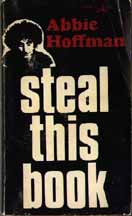 in on what’s going on in the community and around the world. Values, myths, symbols, and all the trappings of our culture are determined to a large extent by the underground press. Each office serves as a welcome mat for strangers, a meeting place for community organizers and a rallying force to fight pig repression. There are probably over 500 regularly publishing with readerships running from a few hundred to over 500,000. Most were started in the last three years. If your scene doesn’t have a paper, you probably don’t have a scene together.”
...
“A heavier scene than even the high schools exists in No-No Land of the military. None-the-less, against incredible odds, courageous G.I.’s both here and overseas have managed to put out a number of underground newspapers. If you are a G.I. interested in starting a paper, the first thing to do is seek out a few buddies who share your views on the military and arrange a meeting, preferably off the base. Once you have your group together, getting the paper published will be no problem. Keeping your staff secret, you can have one member contact with someone from a G.I. coffee house, anti-war organization or nearby underground newspaper. This civilian contact person will be in a position to raise the bread and arrange the printing and distribution of the paper. You can write one of the national G.I. newspaper organizations listed at the end of this section if you are unable to find help locally. The paper should be printed off the base. Government equipment should be avoided.”
...
“Under FCC Low Power Transmission Regulations, it is legal to broadcast on the AM band without even obtaining a license, if you transmit with 100 milliwatts of power or less on a free band space that doesn’t interfere with a licensed station. You are further allowed up to a 12-foot antenna or the use of carrier-current transmission (regular electric wall outlets). Using this legal set-up, you can broadcast from a 2 to 20 block radius depending on how high up you can locate your antenna and the density of tall buildings in the area.”
...
Free food, housing, education, and independent media. Shoplifting, pipe bombs, medical care, draft counseling... and graphic design.
It’s all there in the hipster slang of 1970. While downloading the complete Steal This Book as one big 413 Kb HTML file, read a little about its provenance.
The title joke still makes me laugh. Steal this book about destroying capitalism. But, while some items in the book are still relevant to movement building and perhaps real social change, others seem more like cheap thrills than liberation. 30 years later, Hoffman’s catalogue of techniques of resistence reads as a vision of a life of struggle. The introduction breezes through a snapshot of the ills of America, but get your nuanced political and economic analysis elsewhere — this is just a practical guidebook. Perhaps for those without a nuanced political or economic analysis? “The purpose of part two is not to fuck the system, but destroy it.” By fighting violence and theft with violence and theft? And then what?
Found via Boing Boing.
Collective Agency
“iStockPhoto is a collection of royalty-free files contributed by its members. iStock members are part of an international community of artists which has created a huge database, growing at an exponential rate. Members can download from a collection of images, audio, and Flash, browse through our forums on design and photograph.
Members can now download from a database of hi-rez images, audio, Flash and more for [U.S.] 25 cents per download - new members start with 2 download credits to get accquainted.
Download credits are accumulated either by depositing money into your iStock account or from download earnings. iStock uses $.20 from each download to cover its bandwidth costs, and $.05 (five cents) is returned to the member who uploaded the file. This ensures that regular contributors will always have download credits, and all others can download photos for only $.25 each.”
Most stock photography is out of the financial reach of individuals and organizations without a photo budget. Photodisc, the pioneer of the online stock photo market, charges $50 a pop for its cheapest images. iStockPhoto is a kind of mutual-support initiative providing imagery to its members practically for free.
And, through iStockPhoto the photographer, not the photo agency, retains the copyright of the images. Many stock photo agencies have increasly asked photographers to give away more and more of their rights for less and less money.
Unfortunately, for photographers who depend on income from their imagemaking this grassroots initiative is yet another contender in a crowded market. But for those who believe imagery should be free and who want to share it freely iStockPhoto is a beautiful thing.
Free as in School
In April 2001 MIT President Charles M. Vest announced the plans to make MIT’s courseware freely available on the Internet. On September 30, 2002 MIT launched MIT OpenCourseWare. The online courses include lecture notes, course outlines, reading lists and assignments.
“MIT OpenCourseWare will provide the content of, but is not a substitute for, an MIT education....”
The material is free for non-commercial use and is not for acaedmic credit. From an OpenCourseWare factsheet:
“MIT [OpenCourseWare] is not a distance learning initiative. Distance learning involves the active exchange of information between faculty and students, with the goal of obtaining some form of a credential. Increasingly, distance learning is also limited to those willing and able to pay for materials or course delivery.
MIT OCW is not meant to replace degree granting higher education. Rather, the goal is to provide the content that supports an education.
From President Vest:
“We hope the idea of openly sharing course materials will propagate throughout many institutions and create a global web of knowledge that will enhance the quality of learning and, therefore, the quality of life worldwide.
The pilot falls short of the 500 courses initially planned for the launch, but it’s a very nice start.
We are opening our pilot to the public for review and feedback. It contains a sample of MIT courses, offering an early look at the content and design of OCW. As we pursue our intensive work to find the most effective way to make OCW a valuable resource for all who use it, we will continue to add courses, until virtually all are available.”

