



graffiti
 14 May 2008 |
 To Where, From Whom
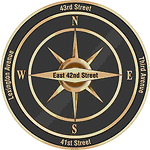
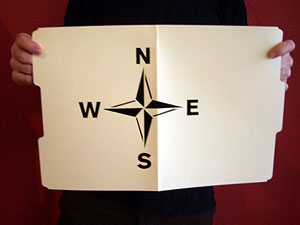
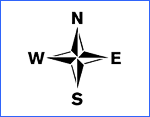 Folks reading my most recent post about the New York City’s implementation of the compass rose by subway exits may have thought the Department of Transportation took its inspiration from my blog. Not so.
I came up with the idea in conversation with out-of-towner Micah Anderson over dinner with the folks from Eggplant Active Media back on March 4, 2006 and later posted it to this blog.
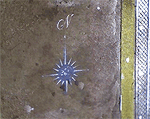
Graffiti roses showed up near downtown exits three weeks later, though I was never sure if my post inspired this. After kottke.org picked up my link, I received this email:
hey man,
i am NOMAD, I have been doing the compass rose graffiti, someone just showed me your post on it,
great minds think alike....
However, while this was all in March 2006, last week’s New York Times article on the DoT’s 2007 implementation of the compass, cites the new transportation commissioner who says she got the idea from “an Upper East Side man who was among about 20 New Yorkers quoted in The New York Times in January 2006 in an article about practical ways to improve the city.”
 But wait, there’s more!
After my post about the official NYC rose was picked up by a couple of blogs, I received an email from Mary Ciuffitelli who says she proposed the idea publicly back in 1992:
Hey John,
I like your website and design, but I have some news for you.
In 1992, I received an award from The Municipal Art Society for this compass rose idea. MAS ran a big competition called Design New York. There were seven winners out of 1500 entries, followed by an exhibit, an awards ceremony, a lot of press (including the New York Times), NBC TV News interviews, etc. I have my original sketch, award letter, ceremony program, tape of the TV interview, all the documents.
Fifteen years ago, there was talk of the city implementing the idea. In the meantime, friends and I talked about going guerrilla and just spray-painting compasses all over the subway system. I wish we had. I was working at a design studio back then, and there was plenty of enthusiasm. We designed a stencil for our plan based on the floor compass in the subway at Grand Central Station. If I keep digging through my stuff, I’ll find that drawing as well.
There were some pretty great ideas that came out of that contest. (Including a submission very close to mine.) Time to look back before setting down the history. This NY Times article boils down my idea to one sentence, but my submission included slightly more elaborate suggestions to reflect neighborhood character and landmarks.
Designing a Better New York, September 24, 1992 http://query.nytimes.com/gst/fullpage.html?res=9E0CE7DA1F3BF937A1575AC0A964958260
Since it looks like the idea is on the brink of becoming a permanent part of New York City design, I would like to set the record straight. Maybe you’d like to help me.Yours in brilliant ideas,
Mary
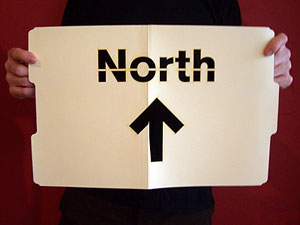
In the meantime, the folks at the Eyebeam OpenLab and Graffitti Research Lab generously let me use their laser cutter to produce a couple of stencils. I have 20 compass roses and 20 North arrows. Want to help put this up?
Send your postal address and PayPal me $2.00 for first class postage and I’ll send you one.
First Responders
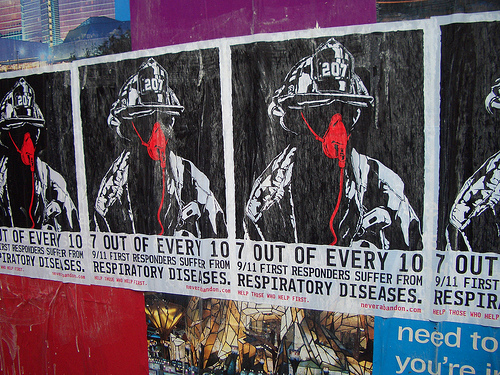
Funny to see police and firefighters making their case with street posters (and with such an ‘oppositional’ style) — considering its the police who enforce the vandalism laws. I guess the streets are it when you feel the government has abandoned you.
Negative Campaigning
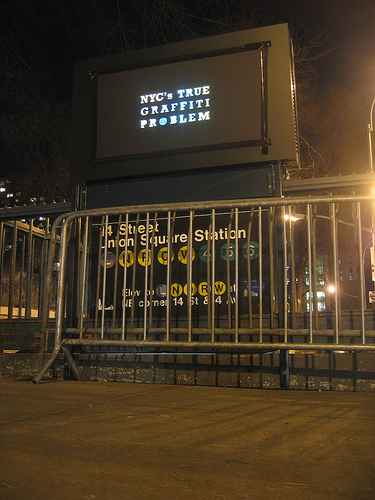
A great action in NYC, taping placards over those outdoor video billboards attached to subway entrances. The typography is composed of holes in the board, illuminated by the video ad beneath.
The project is Light Criticism, brought to you by the Anti-Advertising Agency and the Graffiti Research Lab.
In form, it reminds me of the work of Moose, writing his name on walls by cleaning them.
In context, it’s a lot like this guerilla wayfinding campaign, a grassroots, illegal action for civic improvement.
Ghost Bikes
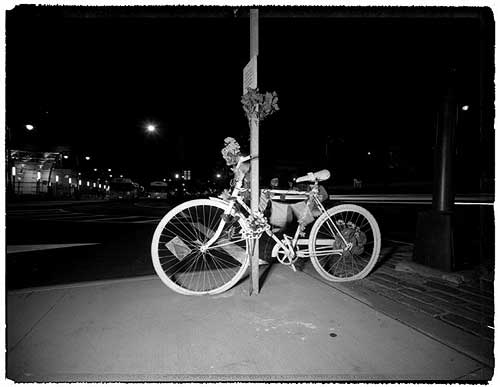
Last week, the New York Times ran a sober photo essay on the ghost bikes that Visual Resistance and Time’s Up! have been installing around New York City since June 2005. The bikes are public interventions, a grassroots action in the spirit of graffiti memorial walls. The bikes are painted white and chained near the site where a cyclist was killed by an automobile, along with a plaque with their name and the date they were killed. Several are plotted on this map.
The bikes were inspired by a similar project in St. Louis, and have since appeared in cities across the U.S. and the U.K.
A 2005 report on bicycle fatalities from the New York City police, parks, health, and transportation departments reports that between 1996 and 2005, 225 bicyclists were killed in crashes with motor vehicles. Between 1996 and 2003, 3,462 NYC bicyclists were seriously injured in crashes.While the annual number of serious injuries has decreased, deaths remained steady during the 10-year period.
The statistics show a failure of urban design and policy — 89% of crashes occurred at or near intersections, 92% of bicyclist fatalities resulted from crashes with motor vehicles — as well as the absence of personal equipment: 97% of the bicyclists who died were not wearing a helmet. 74% of the fatal crashes involved a head injury.
While it’s clear that helmets save lives, something else is broken in NYC: of the 3,964 transportation-related deaths in New York City between 1996 and 2005, only 6% were cyclists. Almost half the deaths (49%) were pedestrians.
Teaching Design
Just flipping through Teaching Graphic Design, another compilation edited by Steven Heller.
The book consists of sample curricula, “Course Offerings and Class Projects from the Leading Undergraduate and Graduate Programs” in graphic design and typography, professional practice, exhibition, and Web design.
Notably absent is much mention of social responsibility. Only one chapter by Stewart Ewan attempts to do so explicitly (with projects on designing flags... and currency. Blah.) Another assignment asks students to design a poster “about human rights.” But to what ends?
This absence of any actual public engagement is particularly striking because Heller’s previous volume, Citizen Designer: Perspectives on Design Responsibility repeatedly and specifically fingers design education as the place where designers go astray and the reason designers are not more socially engaged.
Well, so much for that.
It raises the question, though, of what a book of progressive design curricula would look like.
A little Paolo Freire? A little Augusto Boal? I imagine something written not just for design teachers, but for a broader audience. It might touch on:
- Using design research and problem solving methodolgy to address civic issues
- Designing visual tools for public participation
- Reading assumptions encoded in images, structures, and practices
- Design for community building and advocacy
- Using design to streamline civic processes
- Issues on sustainable design and responsible printing
- Methods of user testing
- Multi-lingual design
It would cover media including:
- Basic typography
- Information design
- Documentary or narrative design
- Posters, graffiti, and street art
- Transportation graphics and civic way finding
- Mapping
- Branding and communications design
- Design for multimedia
It would integrate principles of cost-effectiveness, accessibility and inclusiveness, usability, environmental sensitivity, and technologically appropriate solutions.
Too much for undergrads? Why not throw in some historical analysis of art, design and social movements? An analysis of strategy and tactics... I could go on.
Any takers? Done properly, such book might be useful for grassroots groups and social movements, too. I’m sure there’s grant money to be had.
Call for Entries: Land and Globalization
Via Visual Resistence I found this call for entries:
“SAW (Street Art Workers) is seeking posters for an international street art campaign about land and the effects of globalization. We want you to design and submit posters that will be printed and wheatpasted in cities across Europe and North America. The strongest designs will be published as a mass produced, newsprint poster collection. This will be a 24 page, 2-color newspaper which will include up to 30 posters. SAW will pay for the printing, and volunteers will distribute the posters. The majority of posters will be wheatpasted in public by participating artists and folks who just want to paste up their city.
Based in the U.S., SAW is a network of printmakers, stencil artists, graffiti writers and painters who use the streets for art and activism. We are taking back our cities and towns from the businessmen, cops and politicians who define public space for their own benefit. As a volunteer-run group, we make street art for political campaigns and post each other’s work across North America. Since 2001, our projects have talked about prisons, the mass media and utopian ideas for the future.
We want posters that build connections between international struggles and actual organized projects with high profile publicity. We especially want to see multilingual submissions and work from the perspective of women, Third World communities and indigenous/First Nations. We suggest that artists collaborate with grassroots, social change organizations of their choosing to make posters. We want posters that are both imaginative and relevant to “on the ground” organizing around issues of land, housing and globalization. Working with an organization is not required, but it is encouraged.
It could be argued that Christopher Columbus began our current age of globalization when he washed up on the shores of the New World. The slave trade, imperialism and resource theft that followed in Asia, Africa and America were a brutal beginning for globalization. Today imperial conquest has been refined into cold, impersonal corporate bureaucracies. In the last 30 years these corporations have become economic giants more powerful than many countries. Setting up global assembly lines, today’s corporations move freely around the world forcing countries, rich and poor, to surrender their land, resources and labor. In the process, corporations have made massive profits shifting wealth from the global south to the industrialized north, from the impoverished and working people to the rich and powerful.
SAW wants to look at how this form of globalization has affected our lands and how people are fighting back. How has it affected land in the cities — especially housing? How has globalization impacted land and workers in the countryside with farming, mining, drilling, logging and other resource extraction? What are the connections between land struggles in the global south, indigenous nations and the industrialized north? What are some of the connections between the landless peasants movement of Brazil and the squatter movements of Europe and North America? What links together the struggle against dams in India, hydroelectric projects Canada and water privatization in Latin America and South Africa? How are farmers and campesinos resisting industrial agriculture, like biotechnology and GMOs (genetically modified foods), in the U.S., Mexico and India? What organizing strategies have worked and hich ones have failed? These questions are a starting point. We want to see more questions from you and some hard-hitting answers. We want powerful ideas and inspirational art that we can broadcast directly to the streets in 2005.”

The deadline for submissions is September 1, 2005.
For more info, visit streetartworkers.org
American Graffiti
In January 1991, George Lakoff published Metaphor and War: The Metaphor System Used to Justify War in the Gulf. He showed the discourse of war as ‘a panorama of metaphor,’ documenting, for instance, the state-as-person metaphor “engaging in social relations within a world community.” It’s health is economic health. It’s well-being is wealth. And its strength is military strength.
“War in this metaphor is a fight between two people, a form of hand-to-hand combat. Thus, the US sought to ‘push Iraq back out of Kuwait’ or ‘deal the enemy a heavy blow,’ or ‘deliver a knockout punch.’ A just war is thus a form of combat for the purpose of settling moral accounts....
The fairy tale has an asymmetry built into it. The hero is moral and courageous, while the villain is amoral and vicious. The hero is rational, but though the villain may be cunning and calculating, he cannot be reasoned with. Heroes thus cannot negotiate with villains; they must defeat them. The enemy-as-demon metaphor arises as a consequence of the fact that we understand what a just war is in terms of this fairy tale.
The most natural way to justify a war on moral grounds is to fit this fairy tale structure to a given situation. This is done by metaphorical definition, that is, by answering the questions: Who is the victim? Who is the villain? Who is the hero? What is the crime? What counts as victory? Each set of answers provides a different filled-out scenario.”
There is, of course, no room in these stories for the horror of war or the possibility of popular dissent.
In March 2003, on the eve of the second invasion, Lakoff published Metaphor and War, Again, charting again how the state-as-person continued to circulate. Added to this is the Rescue Scenario in which W. saves the Iraqi people and Saddam’s neighbors, whom he is “threatening.”
While Lakoff shows how metaphors help form conceptual frames that explain and justify military action, Yusuf Progler shows how these are rendered literal in blood and steel — inscribed onto the machinery itself.
From January 1999, Racist and degrading graffiti rooted in America's military culture:
During the last hours of ‘Operation Desert Fox,’ the murderous Anglo-American pre-Ramadan assault on the Muslim population of Iraq, the Associated Press broadcast a photograph of a US Navy missile ‘festooned with disparaging graffiti.’ Subsequent news reports mentioned one of the ‘several inscriptions’ scrawled on the missile: ‘Here’s a Ramadan present from Chad Rickenberg.’
Almost immediately, the offensive graffiti was strategically denounced by Pentagon officials as a ‘rare exception.’ In a statement released to the press, the Pentagon stressed that the graffiti ‘does not reflect American policy’ toward Muslims, adding that the US appreciates the ‘important contributions of Muslim-Americans to the US military.’ But despite the official denial, and though it received no further media attention, the incident is symptomatic of a long-standing legacy.
Aside from the reality that ‘American policy’ toward Muslims has included bombing and starving Iraq into oblivion, letting Bosnians be murdered and raped by Serbian fascists, supporting Israeli aggression in Palestine and Lebanon, destabilizing Iran, and attacking Somalia, Sudan, and Afghanistan, the graffiti incident is instructive in a number of ways. For one thing, it provides a rare glimpse into American military culture....
One need only look to earlier instances for verification. During ‘Desert Storm,’ the 1991 precursor to Desert Fox, reporters discovered the Anglo-American tradition of scribbling messages on bombs. Graffiti of that war ranged from adolescent silliness, such as ‘Hi Mom’ and ‘Say Cheese,’ to a range of witty puns like ‘Seasons Beatings,’ to virulently racist and sexist remarks like ‘Mrs. Saddam’s sex toy’ or ‘a suppository for Saddam.’ While British airmen are known to write messages like, ‘Dear Saddam, have a shitty day, love from the RAF,’ Americans tend to write more sexualized graffiti, with one reporter noting ‘the most identifiably American’ graffiti includes phrases like ‘bend over Saddam.’
Sometimes, US airmen write messages in their own blood. Since all of the weapons are blown to smithereens, and since the graffiti is in English, it seems obvious that the pearls of wrath and wisdom are intended for the artists themselves, almost like an inside joke, which is occasionally made public by news reports....
There’s no doubt that Chad Rickenberg, who painted a Ramadan greeting on a bomb destined to destroy Iraqis, had heard stories of similar acts committed by his predecessors in 1991, when another generation painted its degrading graffiti on bombs also destined to kill Iraqis. The oral tradition in the military passes on its rites of passage, which become badges of honor and belonging.
But such attitudes and practices toward Muslims did not emerge with the recent aggressions against Iraq and Iran. The first American military adventure against the Muslim world was initiated by then president Thomas Jefferson in the early 19th century. Those valiant exploits led to the formation of the American Navy and Marines, and the creation of a racist and phantasmagoric folklore about Muslim ‘barbarians’ and their ‘harems,’ the former to be killed and the latter to be raped. After a bit more practice on Indians and Africans, American soldiers massacred ‘Moro’ Muslims in the Philippines, America’s ‘Indian territory’ of the 1890s. Today, a century later, America’s Indian territory is Iraq. And the legacy marches on.
Indeed, this is made quite clear in this May 5, 2055 photo published on the Marine Corps own Web site. It is a photo of a U.S. tank in Iraq dubbed the ‘New Testament.’ Not only is it written across the barrel beneath the bowed head of the operator, it is highlighted in the caption:
“Haditha Dam, Al Anbar, Iraq - The ‘New Testament’ a tank with 4th Tank Co., 1st Tank battalion attached to 3/25 prepares to lead the way during a recent mission. Photo by: Cpl. Ken Melton.”

See also: Bombing Iraq, on the functions of Iraqi graffiti.
Troubles
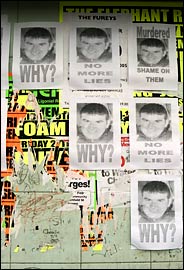 On the topic of posters and terrorism is this piece that ran in the NY Times two days ago about a growing backlash among Catholics to the violence of the Irish Republican Army.
Five sisters are defying intimidation, calling for justice for the murder of their brother and “what is widely seen as a subsequent I.R.A. cover-up.”
As part of the effort, they are posting graphics in the street, both a rallying cry and public defiance of a sector of the community who would silence dissent in the name of the cause.
“Many Catholics in the McCartneys’ neighborhood, a battle-scarred area called the Short Strand, have responded with surprising solidarity.
On the day of the funeral for Mr. McCartney, a popular 33-year-old fork lift operator with two young sons, a thousand people turned up. Graffiti denouncing the I.R.A. popped up on walls, a first in a republican neighborhood; the markings were quickly erased, but quickly reappeared. Small photocopied posters with Mr. McCartney’s photograph appeared on shop windows. ‘No More Lies,’ one said. ‘Shame on Them,’ said another.
Last Sunday, the women held a rally in the neighborhood. Hundreds showed up, including politicians, and several speakers expressed outrage. The sisters held placards that read, ‘Murdered - Who’s Next?’
‘If these men walk free from this, then everyone in Ireland should fear the consequences,’ Paula McCartney, 40, a Queen’s University student, told the crowd, according to news reports. ‘Justice must be done.’”
It is a kind of grassroots resistance to the established resistance, adding further stigma to the violent tactics — from the constituency such tactics are theoretically supposed to benefit.
Still, one has to wonder about the sudden interest of the NY Times in such resistance. The Times is so rarely sympathetic to such activities by left-wing groups. Is it simply the hypocrisy of a righteous group acting less than righteously? Or there another agenda at work? While the I.R.A. may indeed have turned to thuggery (they wouldn’t be the first armed resistance to do so) I suspect a kind of arrogant Statism at play, the sisters provide a convenient proxy to bash those pesky agitators.
Japan at War

Antiwar activists found not guilty over flier distribution
“The Tokyo District Court found three peace activists not guilty Thursday of trespassing at a Self-Defense Forces housing facility in the western suburbs of Tokyo and distributing leaflets in mailboxes expressing opposition to the SDF deployment in Iraq.
They were arrested Feb 27 after trespassing Jan 17 at the SDF residential quarters in Tachikawa, Tokyo, to distribute the fliers urging SDF personnel and their families to consider the appropriateness of sending Japanese troops to Iraq.”
The three spent nearly 2 1/2 months in detention.
Japanese police have become increasingly agressive in their crackdown on peaceful protestors distributing political leaflets.
More from the Japan Times:
“The Feb. 27 arrest of the three, members of local citizens’ group Tachikawa Jieitai Kanshi Tentomura (Tachikawa Tent Village to Monitor the Self-Defense Forces), shocked many civic groups and legal experts, who see it as an attempt by authorities to silence antiwar activists.
The handbills say SDF personnel may inevitably be forced to kill Iraqis and call on the service members to critically assess the government’s decision to dispatch troops to Iraq....
After returning home Tuesday night, one of the three, a 47-year-old worker at a public school in Tokyo, said the arrest and subsequent detention caused irreparable damage to his social reputation and career.
He said that on the day of his arrest, some media reported his name as a criminal suspect, and that he must stay away from work as long as his trial is ongoing.
Established in 1972, the group, which currently has seven members, has been posting handbills at the complex for the past two decades, but members claimed there had never been problems until they posted the handbills in January, drawing complaints from the residents.
...
In April last year, a 25-year-old bookstore employee was arrested for vandalism, after writing antiwar graffiti on the wall of a public lavatory at a park in Suginami Ward, Tokyo. The man said he was questioned by public security police, who grilled him over his political background.
His arrest was unusual, his counsel said, in that instead of the ward initiating a criminal complaint, police approached the ward to do so.
In February, the man was handed a suspended 14-month prison term. He has appealed the case to higher court, claiming his sentence is too harsh for the crime.
In March, a 50-year-old Social Security Agency employee was arrested and charged with violating the National Public Service Law by posting copies of the Japanese Communist Party organ Akahata in more than 100 mailboxes in Tokyo’s Chuo Ward during campaigning for November’s general election.
It is illegal for civil servants to engage openly in election-related activities, but no one has been charged with such an offense since 1967, according to legal experts, although over the years a few have been arrested.
His lawyer said it is unprecedented for a public servant to be arrested for merely posting leaflets. This case was also handled by public security investigators, who raided the man’s home, workplace and the JCP’s office in Chiyoda Ward.
‘Posting leaflets is the most peaceful means and one of the few tools powerless citizens have to convey their message,’ said Katsuko Kato, a 66-year-old cram school teacher who heads the Tachikawa citizens’ group. She added that peace activists targeting SDF bases widely employ the tactic.
‘This (renewed) oppression of citizens’ voices and the rights of those in the military to have wide access to information was something that was prevalent during the war. It reminds me that Japan is again at war,’ she added.”
Of course, article 9 of Japan’s Constitution forbids the country from engaging in war:
“Aspiring sincerely to an international peace based on justice and order, the Japanese people forever renounce war as a sovereign right of the nation and the threat or use of force as means of settling international disputes. 2) In order to accomplish the aim of the preceding paragraph, land, sea, and air forces, as well as other war potential, will never be maintained. The right of belligerency of the state will not be recognized.”
That is, the same Constitution drafted by the occupation government of the United States military in 1946.
Read more about the history of Tachikawa Tent Village to Monitor the Self-Defense Forces.
See this previous post on recruiting graphics for Japan’s Self-Defense Force.

