



gov
One Weekend a Month My Ass!
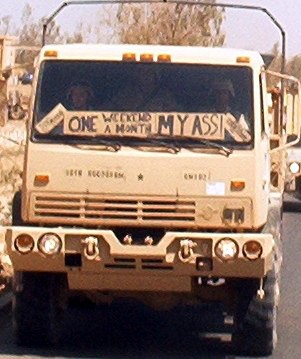
A U.S. reservist in Iraq emails a photo to a friend back home. Friend posts it on his blog. The image is widely circulated by email, and ultimately finds mention in The New York Times a month later.
The war drags on. Tours of duty are extended. U.S. soldiers continue to kill and be killed. Dissent among the military and military families smoulders.
And the scholarship funding? Job skills? Veteran’s benefits? One weekend a month?
See these articles about the myths and messages in military graphics and advertising sold by recruiters to high school and college students across the United States of America.
Redesigning the High Line


“Designing the High Line” is an exhibition of ideas for the conversion of the High Line elevated rail structure to public space. The exhibit is showing in Grand Central Terminal until July 26. 720 entries were submitted from 36 countries. More than 100 of the proposals, including the competition winners, are displayed in the Grand Central exhibit. All 720 entries are displayed on the Web site.
In addition to the four principal winners, designs were selected for special cash awards for depicting the most compelling solution for universal access to the elevated structure, and for incorporating plants and wild flowers native to New York. (Pictures are posted here and here, though difficult to read.)
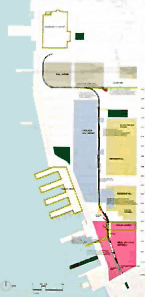
The High Line runs for 1.45 miles over Manhattan’s West Side, from 34th Street down through Chelsea to Gansevoort Street in the Meat Packing District. The High Line was built during one of New York City’s largest infrastructure projects, the West Side Improvement project. The project took place in the early 1930’s during the Great Depression and was presided over by Robert Moses. The Line carried freight above the streets of the West Side until 1980, when the last boxcars hauled a load of frozen turkeys down the tracks. The structure has been inactive since, collecting trash, shedding rust, and sprouting an elevated garden of weeds and wildflowers. [more history here]
In 1992, the Chelsea Property Owners, a coalition of two dozen businesses who own property under and near the Line — mostly parking lots, machine shops, warehouses, and the trendy Chelsea Market — won a conditional demolition order from the Surface Transportation Board. The proposal to tear down the Line was later supported by Mayor Giuliani. The plan never materialized because the coalition and the railroad’s owner at the time, Conrail, could not agree on an ultimate price tag for demolition. [source]
Through the economic boom of the 90’s, however, new residents moved into the neighborhoods below the Line, among them artists, designers, and galleries. In 1999, an altogether different group of neighborhood residents founded Friends of the High Line, a 501(c)(3) non-profit organization with the mission of converting the structure to an elevated public space.
 And, after much lobbying, it looks like the High Line might actually be redesigned. At the July 9 benefit preview of the exhibition, New York City Council Speaker Gifford Miller announced a $15.75 million funding commitment for planning and construction. The first $750,000 was allocated in the budget adopted by the New York City Council on June 27.
“The funds can be used for planning, design, and construction costs related to the High Line project during the fiscal year that began July 1. The remainder of the $15.75 million commitment will be allocated to the High Line in the following three fiscal years.
‘The High Line was built during the Depression to invigorate New York’s economy, and it will reinvigorate our City again today,’ said Speaker Miller. ‘As we have learned from our City’s great parks, public spaces create value and catalyze growth. Central Park was planned in a recession. Even in tough economic times, we have to invest in our future—by planning for the public projects that will keep us at the forefront of the world’s great cities.’
The funds will come from the City’s capital budget, which pays for project costs such as planning, design, construction, and long-term leases. The allocation will not affect municipal services, which are funded separately through the City’s expense budget.” [source]
 The Friends of the High Line are also seeking private, corporate, foundation, and federal funds for the project.
The competition follows two detailed planning studies: Reclaiming the High Line, sponsored by Friends of the High Line and the Design Trust for Public Space; and a comprehensive economic feasibility study, commissioned at the City’s request.
In December 2002, the City of New York took the first step in converting the High Line to a public walkway through federal rails-to-trails legislation. FHL is currently waiting on decision before Federal surface transportation board to allow City to move forward.
“As the next phase in its project to preserve and re-use the High Line, Friends of the High Line will hold a series of open workshops with members of the community beginning in September, with a variety of the competition proposals serving as springboards for discussion. At the end of 2003, Friends of the High Line will incorporate the community’s comments into a Request for Proposals, which will lead to the development of realizable designs.” [source]
The High Line is currently private property, owned by the rail company CSX Corporation. CSX acquired the High Line when it purchased Conrail in 1997. Conrail was created by the federal government in 1970’s from the remains of the New York Central and other railroads bankrupted by “competition from trucks, subsidized by the federally-built Interstate highway system, and an archiac system of economic regulations which prevented railroads from responding to the needs of the market.” The corporation was sold to the public in 1987, in what was then the nation’s biggest IPO. [more on Conrail] Though the High Line is private property, the federal government, specifically the Surface Transportation Board, has control over the Line as a piece of the nation’s rail infrastructure. CSX has been ordered by the government to work with all interested parties to effect the best exit strategy for the High Line, and to remain neutral as to the High Line’s outcome.
The City can not afford to purchase land under High Line, so has instead proposed rezoning and property transfer, moving air and development rights out to sites around West Chelsea. One potential consequence would be a wall of huge residential towers springing up along 10th and 11th Avenues in otherwise moderately sized manufacturing and retail zones. One challenge faced by city planners is the prevention such “massing.”
The High Line snakes through many neighborhoods and buildings, but sits almost entirely within the area served by Manhattan Community Board No. 4. The current Line blocks sunlight, collects trash, and drops water, rust, and pigeon droppings on the streets below. However, according to a survey by the Board, most community residents support conversion over demolition. They want to make sure, though, that the results of the redesign are the best damn park possible. The community is wary of new large-scale structures or billboards that would block sight of or access to the Hudson River. The project should provide open space for cultural programing, be accessible, and safe, providing a way to get up or down quickly. But most of all, it should connect with and respect the community. Some residential buildings sit within 5 feet of Line.
As development proceeds, areas beneath and adjacent to High Line will become lucrative spots for retail. Indeed, represenatives of our businessman-turned-Mayor is keen to move some of that retail up onto High Line itself. Other possibilities include constructing adjacent buildings with roof access that would meet the High Line or produce huge urban stairs, parks that terrace up to the bed of High Line, which is about 30 feet from the ground.
At a panel discussion, I asked Robert Hammond, co-founder of Friends of the High Line, about their advocacy strategy and how design competition fits into it. The competition took a year to organize from beginning to end and was a way to get people excited, to generate activism and support, and to provide a public platform for discussion. He noted the power of crazy, weird ideas - and how it is often easier to draw attention and support for the crazy ideas than the conservative plans. Another panelist noted that, when not located to a specific neighborhood, the constituency of public open space is transient and often does not have a consistent voice. The competition was an opportunity “to get those ideas out there.” Over the years, many have developed redesigns of the High Line for their thesis projects.
I asked Mr. Hammond what has led to their success to date while civic budgets are being cut and other projects around the city have faltered. Mr. Hammond proposed that the support base was “not the usual mix of neighborhood advocates.... The strongest supporters are architects, artists, art dealers.” Indeed a list of supporters at the gala benefit includes many A-list authors, actors, and artists. Not your usual city planning scene.
Mr. Hammond also noted that the design of their campaign materials was also key. Several designers have donated services to develop graphically sophisticated materials. Brochures, Web site, postcards for public comment... “Everything produced looks interesting. It suggests that the final design will be as innovative.”
Ironically, development of the High Line may push many in the arts community to leave the area. When the project is complete, rents around the Line are likely to increase. Many arts spaces are already midway through their 10 year lease, and unable to afford the current market rents. Part of the development plans could create public spaces that would not command retail rents and could support galleries, though these would be limited.
So how will the crazy ideas not get lost, or bogged down by politics? And allow ultimate designer to maintain poetic vision? The challenge is yet to come. Once New York realizes that the project is possible, everyone will want a piece of the action. It will be important to maintain a clear vision, and to make sure the final product is as extraordinary, interesting, and strange as the High Line itself.
Check out these photo galleries on the current state of the High Line.
The High Line was mentioned here in one of my first blog posts.
NYC Recycles Again
 Apologies for the lack of updates lately. I’m just back in town from travels and have a whole stack of notes to write up.
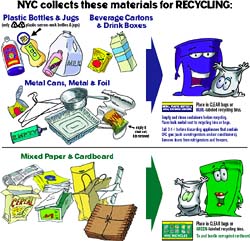
In the meantime, I’m very happy to announce that New York City has started recycling again. Plastic recycling resumed on July 1. Glass recycling will resume in April 2004. Here’s the Department of Sanitation press release and poster.
Recycling was suspended last year as part of Mayor Michael Bloomberg’s plan to cut costs and fend off a projected $5 billion deficit. A year later, at a recent City Council budget hearing, Sanitation Commissioner John Doherty conceded that the projected savings from cuts to recycling never actually appeared. [source]
The City Council worked out the deal with the Mayor to resume recycling in a recent budget agreement.
The city will pay Hugo Neu Schnitzer East $51 per ton to handle the material, making the cost of processing the city’s recycling less expensive than processing its trash. According to HNSE, the city currently pays an estimated $105 per ton for the transportation and disposal of plastic and glass in the solid waste stream.
“[With the acceptance of the bid,] HNSE will build a multi-million dollar, state-of-the-art recycling facility in the Hunts Point section of the Bronx that will bring more than 40 high-paying, unionized jobs and numerous economic benefits to an impoverished area of New York City. Moreover, since HNSE operates one of the metropolitan area’s largest barge fleets, the development of the new recycling facility would create little additional truck traffic—indeed, the new facility would actually remove truck traffic from city roads and highways.” [source]
Building an recycling infrastructure in NYC is a wonderful thing, but I wonder about the environmental impact of the recycling plant itself. Residents of the South Bronx already endure much of the City’s waste transfer and incineration. Children living in East Harlem are three times more likely to have asthma than children living on the Upper West Side, and 25% of children from the South Bronx have asthma. As plans for the new recycling facility was just announced, the South Bronx Clean Air Coalition is seeking further information in order to evaluate the impact on health and traffic in the area.
Dell Stops Using Prison Labor
 This just in: yesterday Dell Computer announced it will use two new vendors for its electronics recycling, and will stop using a vendor that relies on prison labor. Congratulations to the many individuals and organizations involved in the campaign urging Dell to do just that. Just last week, the Silicon Valley Toxics Coalition released a report on the recycling processes used by Hewlett-Packard and Dell. The report contrasts the primative conditions and toxicity of Dell’s contractor, UNICOR, with the efficiency and safety of Hewlett-Packard’s vendor, Micro Metallics. The UNICOR facility is a maximum-security federal prison. The Micro Metallics facility is staffed by union workers paid a living wage.
A Dell spokesman denied that the decision was the result of public pressure, claiming both the decision to use UNICOR and the decision to drop it were based entirely on cost. UNICOR is a corporation run by the U.S. Federal Bureau of Prisons.
See this previous blog entry on the campaign.
ISO
 The International Organization for Standardization is an international non-governmental organization that coordinates the development of voluntary technical standards.
ISO is a network of the national standards institutes of 146 countries with a Central Secretariat in Geneva, Switzerland, that coordinates the system. National standards institutes, not governments themselves, are eligible for membership. Each country sends only one member, and each member has one vote.
The ISO does not regulate or legislate. It’s standards are developed by international consensus among “experts drawn from the industrial, technical and business sectors... experts from government, regulatory authorities, testing bodies, academia, consumer groups or other relevant bodies.”
“There are more than 2,850 of working groups in which some 30,000 experts participate annually. This technical work is coordinated from ISO Central Secretariat in Geneva, which also publishes the standards.
Since 1947, ISO has published more than 13,500 International Standards. ISO’s work programme ranges from standards for traditional activities, such as agriculture and construction, through mechanical engineering to the newest information technology developments, such as the digital coding of audio-visual signals for multimedia applications.
Standardization of screw threads helps to keep chairs, children’s bicycles and aircraft together and solves the repair and maintenance problems caused by a lack of standardization that were once a major headache for manufacturers and product users. Standards establishing an international consensus on terminology make technology transfer easier and can represent an important stage in the advancement of new technologies.
Without the standardized dimensions of freight containers, international trade would be slower and more expensive. Without the standardization of telephone and banking cards, life would be more complicated. A lack of standardization may even affect the quality of life itself: for the disabled, for example, when they are barred access to consumer products, public transport and buildings because the dimensions of wheelchairs and entrances are not standardized.
Standardized symbols provide danger warnings and information across linguistic frontiers. Consensus on grades of various materials give a common reference for suppliers and clients in business dealings.
Agreement on a sufficient number of variations of a product to meet most current applications allows economies of scale with cost benefits for both producers and consumers. An example is the standardization of paper sizes.” [source]
The internatinoal technical standards also include international safety standards for products including toys (ISO 8124-1:2000), camping tents (ISO 5912:1993), bicycles (ISO 4210:1996), and contraceptive devices (ISO 8009).
In 1987, the ISO expanded to develop “generic management system standards.” ISO 9000 is set of a quality management guidelines that apply to all kinds of organizations in all kinds of areas. Once the a quality system is in place, an accredited external auditor can certify that your quality system has met all of ISO’s requirements. They can then issue official certification that you can use to publicize that the quality of your products and services is managed, controlled, and assured by a registered ISO 9000 quality system.

 ISO 7001, “Graphical symbols for use on public information signs,” is a set of international symbols based on the “ISOTYPE” system of icons and pictograms introduced by Otto Neurath in the 1936. However, soon after the 7001 was published, it was determined that the standard international symbols did not have a standard meaning or clarity in every country. Published in 1989 and revised in 2001, ISO 9186 is a procedure for user testing of graphic symbols to determine which symbols communicate the intended meaning most readily to most people. There are two main test methods: a comprehensibility judgment test and a comprehension test. [source] Pictograms with exceptionally high comprehensibility in several countries can eventually become part of the ISO 7001 set.
ISO 13407 “Human centred design processes for interactive systems” provide guidelines for the planning and management of usability testing in the development of computer systems.
In 1993, the ISO established a technical committee, ISO/TC 207 to develop standards for “Environmental management.”
“This move was a concrete manifestation of ISO’s commitment to respond to the complex challenge of “sustainable development” articulated at the 1992 United Nations Conference on Environment and Development in Rio de Janeiro. It also stemmed from an intensive consultation process, carried out within the framework of the Strategic Advisory Group on Environment (SAGE). SAGE was set up in 1991 and brought together representatives of a variety of countries and international organizations — a total of more than 100 environmental experts — who helped to define how International Standards could support better environmental management.
Today, national delegations of environmental experts from 66 countries participate within ISO/TC 207, including 27 developing countries. In addition, 35 international non-governmental and business organizations participate as liaison organizations. The national delegations are chosen by the national standards institute concerned and they are required to bring to ISO/TC 207 a national consensus on issues being addressed by the technical committee. This national consensus is derived from a process of consultation with interested parties in each country.” [source]
The committee works in hand with ISO/TC 176, which develops the ISO 9000 family of standards for quality management and quality assurance.
“ISO 14000 refers to a series of voluntary standards in the environmental field under development by ISO. Included in the ISO 14000 series are the ISO 14001 EMS Standard and other standards in fields such as environmental auditing, environmental performance evaluation, environmental labeling, and life-cycle assessment. The EMS and auditing standards are now final. The others are in various stages of development.” [source]
ISO 14001 certification remains valid for three years and requires audits performed at least annually.
While U.S. environmental regulations do not apply outside of U.S. territory, ISO 14001 applies to all of your operations:
“Perhaps the most significant factor accelerating ISO 14001 compliance is the ever-increasing globalization that characterizes the auto industry. More and more, auto manufacturing is mirroring airplane manufacturing: parts and components might be manufactured anywhere, and assembly might occur anywhere.
This means that a single automaker can have multiple facilities all over the world, under the same corporate umbrella, which require a consistent EMS and measurable results in order to operate competitively. ISO 14001 is one of the best ways to ensure that these needs are met.” [source]
UPDATE: See my August 5, 2003 blog post ISO 14001 Reconsidered.
 24 June 2003 | LINK | Filed in
accessibility, gov, org, product, recycle, standards, transport, united nations
24 June 2003 | LINK | Filed in
accessibility, gov, org, product, recycle, standards, transport, united nations
California Senate Passes E-Waste Bill
On June 4, 2003 the California Senate approved a bill that would require electronics manufacturers to recycle discarded computers and electronics equipment, and to set up and fund a recycling infrastructure. From news.com:
“If the bill is signed into law [by the state assembly and Governor Gray Davis], manufacturing companies by the beginning of 2005 would have to arrange for the recovery of 50 percent of all machines sold during the preceding year. That rate would grow to 70 percent in 2007 and 90 percent in 2010. According to the bill, just 20 percent of obsolete computers and TV sets are currently recovered for recycling. Under the bill, companies could either set up and finance state-approved drop-off programs, under which people could bring their older computers, or the companies could pay the state to do it. They would also have to develop recycling plans....
Governor Davis last year vetoed a bill similar to SB 20, but that earlier bill didn’t allow high-tech companies the option to run such programs themselves, as the new one does.
Although the current bill would affect only those companies doing business in California, the state, which is home to the tech-heavy Silicon Valley, often leads the country in environmental and other trends. Similar bills have been proposed in other states and in the U.S. Congress.”
See the text of Senate bill SB 20.
Other city and county-level initiatives mandating electronics recycling and “take-back” programs are also moving forward throughout California.
The Federal National Computer Recycling Act was introduced in the House on March 6, 2003 by Mike Thompson (Democrat, Napa Valley, California). The bill proposes a fee on all computer and peripheral sales. The fee would fund local programs to collect, reuse, resell, or recycle computer equipment. Gear would be exempt from the fee if its components are likely to be reused or disposed of properly. The bill also mandates a Congressional study on the health and environmental impact of materials used in computers. The bill covers other consumer electronics that “contain a significant amount of material that, when disposed of, would be hazardous waste.”
A Game of Hearts
 On April 11, 2003 the U.S. military released their list of most-wanted senior Iraqi government in the form of a deck of playing cards.
The cards were designed by staff of the Defense Intelligence Agency and the 3401st and 3418th Military Intelligence Detachments. One of the designers, Sergeant Scott Boehmler, 27, an Army reservist from Hazleton, Pennsylvania reports, “We understood what guys like to do on their downtime. This is an effective way of getting these images in the soldiers’ minds.”
Images can be downloaded from the Department of Defense Web site in HTML or PDF.
Production of the cards was widely covered in the U.S. mainstream media and treated as a significant event in the war. Subsequent reports of the arrest of Iraqi officials frequently refer to the list, even noting when an arrested official is not on the list. The reports are occasionally illustrated with an image of said official’s playing card.
The decks have also become enormously popular with the public. Web sites have sold hundreds of thousands of decks. As of May, one company reported $1.5 million in sales. It’s one thing to sell a war to the public. It’s whole other matter for them to buy it themselves in droves. I’ve even seen street vendors in NYC selling the decks alongside the knockoff sun glasses and watches and received a couple of unsolicited email messages offering the decks for sale.
U.S. military personnel are the world’s largest consumers of playing cards, according to Cincinnati-based United States Playing Card Company, the world’s largest playing card manufacturer. According to Time (May 12, 2003) the extreme popularity of the most-wanted cards prompted the distributor to reissue cards created for the military in earlier wars. During World War II “spotter decks” were produced for troops to distinguish between Allied and enemy aircraft. During the Vietnam War “decks containing only the ace of spades were passed out to U.S. troops, who would display a card on their helmets to scare away the Viet Cong — supposedly superstitious about the card, which fortune tellers considered a harbinger of suffering and death.”
The cards have inspired a genre of spinoffs.
GreatUSAflags.com has followed up with U.S. Military Heroes playing cards “honoring America’s servicemen and women involved in Operation Iraqi Freedom.” The deck also features images of aircraft, ships, submarines, aircraft carriers, vehicles and missiles deployed in battle.
On April 25, global justice group, the “Trade Regulation Organization,” released their U.S. Regime Change cards [image, PDF 6MB]. The group, “estimating that the U.S. governing regime is no longer consistent with world peace or prosperity, hopes that the playing cards will show the way to regime change and, eventually, large-scale war crimes proceedings.”
On May 1, Greenpeace International released a deck of “most wanted” cards depicting the nuclear powers of the world. [PDF, 96K] “This deck is designed to help delegates to the Non-proliferation Treaty meeting recognise owners of weapons of mass destruction. Packed with nuclear weapons of mass destruction facts. Fun for the whole family.” Says Tom Clements, senior campaigner with Greenpeace, “It ties the anti-war message together with the disarmament message.”
 On May 7, the conservative Web site NewsMax announced the Deck of Weasels [image] which features images of anti-war celebrities and politicians includes Michael Moore, Tim Robbins, Jacques Chirac, Barbara Streisand, Teddy Kennedy, Kofi Annan, Vicente Fox, Jean Chretien,
  Senator Ted Kennedy and Robert Byrd. Each card features a quote by the celeb opposing the U.S. invasion of Iraq. Each of the photographs has been altered so each figure wears the beret of Saddam Hussein’s Republican Guard.
On May 15, the Ruckus Society released America’s War Profiteers, a deck of cards identifying 53 individuals and institutions in the oil, military, government, media, and policy sectors. “The groups’ aim is to expose, ‘The links among corporations, institutions, and government officials that profit from endless war.’” The site also features a good set of links to articles and campaign pages.
On May 23, Nitestar Productions released “The Deck of Republican Chickenhawks,” depicting the 54 Republican officials, congressmen, politicians and pundits who avoided serving their country through connections, deferments, or other excuses.” Needless to say, many of the officials vigorously supported the U.S. war on Iraq. The deck was inspired by a list maintained by the New Hampshire Gazette of Republican politicians and pundits who have never served in armed combat.
Still other decks reported in the May 18 Washington Post:
“Republicans in the Texas legislature had cards made depicting the state’s ‘most-wanted Democrats’ — the lawmakers who fled to Oklahoma to scuttle a vote on a bitterly contested Republican redistricting plan....
Inspired by the Pentagon’s cards, Frances Gomez, 23, decided to print up card sets featuring her top 55 Cuban villains. But just before the printing order was sent out, Gomez tweaked her plan in hopes of really sticking it to Fidel Castro. She decided to make the cards look like dominoes, the real king of the board games in Little Havana and just about anywhere else that Cubans gather.
So, instead of being the ace of spades — the card reserved for Saddam Hussein in the Pentagon’s deck — Fidel is the Double Nine, the domino tile that no player wants to hold at the end of a game. Gomez needed help from Cuban American groups in Miami to compile her list. She was born in the United States and says, like many Cuban Americans her age, that she knew little about the details behind the deep animosity felt toward Castro and his allies by older generations that fled the island nation.
‘It’s important to learn who these people are,’ Gomez said.”
In addition to the playing cards are recent political trading cards.
 In 1991, trading card publisher Topps (coordinating with the Pentagon and Navy Department) published 3 sets of Desert Storm Trading Cards. In 2001, they published a series of Operation Enduring Freedom Trading Cards.
An article in the Guardian notes:
“90 glossy cards featuring US political and military leaders, the patriotic response to the September 11 attacks, and military hardware.... The series also features a photograph of flowers laid outside the US embassy in Pakistan in the aftermath of the September 11 atrocities. No corresponding card shows the subsequent angry demonstrations against the US bombing campaign.... Topps would not directly respond to charges that the cards promoted an unquestioning view of the war to children.”
Kingsley Barham, publisher of marijuana trading cards that cover hemp history, politics, types, and uses, developed a set of trading cards about the September 11 attacks, Heroes of the World Trade Center. Despite approval from families of victims whose portraits are on the cards, the cards were met with outrage by politicians and the media. The New York City mayor Michael Bloomberg urged lawyers to find ways to prevent the sale of the cards.
 Satire decks of the U.S. “war on terrorism” include American Crusade 2001+, Unofficial Iraqi Freedom Action Cards, and the images of Playing the Hitler Card, a small collection of cards with images of dictators and links to pages were they have recently been compared to Hitler.
In September, 2002 Slate published the Flash animation Corporate Scandal Trading Cards, “the fastest guide to America’s top 10 business crackups” with names and photos of CEO’s along with some statistics and a brief description of the crimes and frauds of WorldCom, Enron, Global Crossing, Adelphia, Tyco, ImClone, Halliburton, Harken, Qwest, and Andersen Consulting.
In April 2000, Texans for Public Justice produced a set of Bush League trading cards. The 20 cards feature statistics and a profile of a Bush “Pioneer” who has raised at least $100,000 for Bush’s presidential election. The profiles are drawn from TPJ’s investigation into the 212 announced Bush “Pioneers.”
 On the heels of their 1989 comic book “Brought to Light: Thirty Years of Drug Smuggling, Arms Deals, & Covert Action,” in 1990 Eclipse published the original Friendly Dictator Trading Cards. The hallucinogenic artwork of Bill Sienkiewicz illustrates “three dozen of America’s most embarrassing ‘friends’, a cunning crew of tyrants and corrupt puppet-presidents who have been rewarded handsomely for their loyalty to U.S. interests.” Other political trading card sets published by Eclipse include “Drug Wars,” “The Iran Contra Scandal,” and “Rotten to the Core - New York Political Scandal,” and “Coup D’etat,” which presents theories pertaining to the assassination of President John F. Kennedy.
Douglas Rushkoff’s 1994 book Media Virus quotes journalist and Eclipse editor Catherine Yronwode:
“Our trading cards are designed so they read like Hypercard stacks. Each cross-references to other cards... They all connect, and you can rearrange them in chains of interconnectivity. Or chronologically. You can find out who someone’s boss was, how different people moved around, that this guy was in Vietnam at the same time as this guy, and then that they were both in Nicaragua at the same time, too.”
Eclipse’s “Crime and Punishment” and “True Crime” cards, which present information about serial killers and gangsters, prompted the Board of Supervisors of Nassau County to pass Local Law 11-1992 which made it illegal to disseminate “indecent crime material to minors.” From the Friendly Dictators site:
“In 1997... a U.S. federal appeals court struck down a Nassau County, New York law banning the sale of trading cards depicting ‘any heinous crime". The court found for Eclipse who had challenged the law on First Amendment grounds - cf: Eclipse Enterprises, Inc. v. Gulotta (U.S. Federal Court of Appeal, 2nd Circuit, December 1997). The expense of this court case seems to have bankrupted them - at any rate, for whatever reason, Eclipse appears to have folded. There are no web entries for the company, no listing in any of the Publishing Indexes I’ve been able to find, and all its products are out of print, as far as the big web booksellers are concerned.”
Details of the case and proceedings can be found here.
Green, Low-Income Housing in Santa Monica
Colorado Court is a 5-story, 44 unit single room occupancy apartment complex for low income tenants in Santa Monica. It is also one of the first buildings of its kind in the United States that is 100% energy independent, generating nearly all its own energy for electricity, heat and light.
Architectural Review, November 1, 2002:
 “In both siting and form, the building has been designed to exploit passive environmental control strategies such as natural ventilation, maximizing daylight and shading south-facing windows. But it also incorporates a number of innovative energy generation measures, notably a natural gas-powered turbinecum-heat recovery system that generates the base electrical load and services the building’s hot water needs. Photovoltaic panels set in the walls and roof supply most of the peak-load energy demand. This co-generation system converts natural gas into electricity to meet the building’s power needs. The same system also captures and uses waste heat to produce hot water and space heating for residents throughout the year. Unused energy from the photovoltaic panels is returned to the grid during the day and retrieved at night as needed. The architects estimate that these energy generation and conservation systems will pay for themselves in less than 10 years and annual savings in electricity and natural gas bills should average around $6000....
Details such as fluorescent lights which automatically extinguish when a room is not in use, insulation made from recycled newspapers, a bike store, CFC-free refrigerators and a trash recycling room reinforce the evangelical message. As many of the technologies are relatively unproven, it is hoped that in its intelligent exploration of the potential of sustainability, the building will act as a successful demonstration project for developers, planners, politicians, architects and, most especially, the wider public.”
The apartments themselves are 375 square feet studios with a kitchenette and a small bathroom. Shared areas include a lounge, laundry, and courtyard.
The project falls under Santa Monica’s “Sustainable City Program” which tries to reduce electricity and water consumption, and install photovoltaic cells on in public and private projects.
Los Angeles Times, June 26, 2001:
“A host of public and private entities—including the cities of Santa Monica and Irvine, Southern California Edison and the California Energy Coalition—are involved in planning, funding and monitoring the innovative building. The two cities, the conservation group and the utility have formed a group known as Regional Energy Efficiency Initiative, which has contributed about $250,000 to energy-saving devices in the building. In addition, Santa Monica itself is contributing about $250,000 toward electricity generators.
The building will be loaded with energy-saving and environmentally benign or ‘sustainable’ devices. Heat from the micro-turbine will produce hot water, eliminating the need for a conventional water heater....
 Prevailing breezes will cool the building, which will have no mechanical air conditioners. The U-shaped structure ‘acts like a giant wind scoop,’ said architect Larry Scarpa, a principal of Santa Monica-based Pugh & Scarpa.
In yet another ‘green’ flourish, the building will collect all the rainwater from the alley behind the property and funnel it into a series of underground chambers. The water will slowly percolate back into the soil, which will filter the pollutants from the water while preventing contaminated water from spilling into Santa Monica Bay. The drainage system was paid for separately by the city of Santa Monica.
The concept of a building that would be energy self-sufficient emerged about two years ago, when Santa Monica officials met with members of the California Energy Coalition. The city’s Housing Division, which funds construction of low-income housing, chose to make a low-income housing project into a dream project of ‘green’ construction, and Colorado Court became the target.
‘We needed a demonstration project because a lot of developers feel that the technologies are unproven,’ Raida said.
 A number of apartment buildings in Santa Monica and Irvine are to be equipped with energy-saving technology by the Regional Energy Efficiency Initiative, but the Santa Monica building is the only project attempting to provide its own power as well.
Rebates from the state Energy Commission helped defray the high cost of the energy-generating equipment. The state’s rebate on the solar panels, which cost about $225,000, will be about $62,000. The $57,000 micro-turbine and heat exchanger will yield a $15,000 rebate from Southern California Gas Co.
If recent research and development has yielded new ways of conserving energy and producing electricity, regulations and building codes have not kept pace.
In one instance, architects had to obtain special permission from the city to hang solar panels outside the exterior stairwells because building inspectors said the solar panels ‘enclosed’ the stairwells and triggered requirements for floors, ceilings and fire-rated walls.”
Santa Monica Mirror, December 6-12, 2000:
“[Architects] Pugh Scarpa Kodama and the Community Corporation have been working with the City of Santa Monica and Southern California Edison to come up with an ‘incentive-type’ plan, which would allot a certain amount of energy to each resident per month, and would award those who did not use the full amount with rebates on their energy bills....
Colorado Court’s units will rent for between $316 and $365. They will be available to low-income residents culled from the Community Corp’s waiting list, who meet the low-income requirements for this building. Twenty-two units will be rented to people making less than $12,775 yearly, another 22 to those making less than $14,600 yearly (these figures are based on 35 - 40% of the current median income of $36,500). According to Raida, the typical demographic for a building such as Colorado Court would include full time workers earning minimum wage, and people on fixed incomes such as retirees and the disabled.
The Community Corp’s waiting list currently numbers over 1,000 people.”
It’s great that the org’s and the city could pull together $5.8 million to build high-tech, green, low-income housing. But, experimenting on the poor for their demonstration project? Is this the flip side of environmental racism? Get some low-income tenants to live inside your the unproven technology? No air conditioning in Southern California? An experimental powerplant in the basement, and less-than-fire-rated exterior walls... that cover a fire exit? Evangelical indeed.
25 May 2003 | LINK | Filed in
built, energy, gov, housing, org, racism, recycle, solar, sustainability
Promises


Yeah... um... we believe you. But, um... actually, we really don’t want you here.
More promises and warnings, more images here and here of the millions of U.S. and U.K. leaflets dropped over Iraq.
Lost in Translation
“Much has already been made of the thumbs-up gesture that British and American soldiers have received from ‘welcoming’ Iraqis. Unlike in many western cultures, in the Middle East the thumbs-up can be an insult, roughly translating as ‘up yours’. But the US Army’s Defense Language Institute says that after the first Gulf War, the gesture was adopted by some Iraqis, along with the ok sign, as a ‘symbol of co-operation and freedom’.” (BBC)


