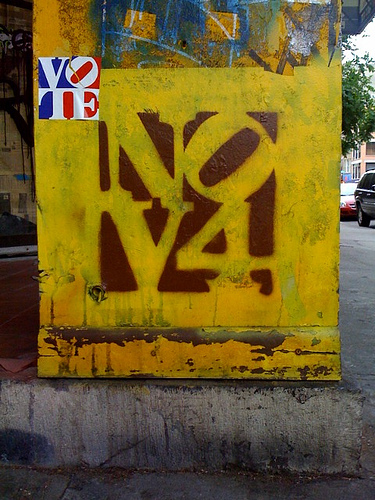


November 2008
 Graphic artist, organizer and member of the Student Nonviolent Coordinating Committee, he popularized the image of the clenched-fist as a symbol for the New Left. He died Monday, November 24, 2008. More at Art for a Change, NY Times and The Rag Blog.
 30 November 2008 |
 To the Spoils, Go the Victories
2012 |
Candidates who spent the most won 94 percent of House races and 79 percent of Senate races. |
2010 |
In 85 percent of House races and 83 percent of Senate races, the candidate who spent the most money ended up winning. |
2008 |
“In 93 percent of House of Representatives races and 94 percent of Senate races... the candidate who spent the most money ended up winning.” |
2006 |
“In 93 percent of House of Representatives races and 67 percent of Senate races... the candidate who spent the most money won.” |
2004 |
“In 95 percent of House races and 91 percent of Senate races... the candidate who spent the most money won.” |
2002 |
“Just over 95 percent of U.S. House races and 75 percent of Senate races were won by the candidate who spent the most money.“ |
2000 |
“The candidate who spent the most money won 98 percent of the elections for positions in the House of Representatives. In the Senate the percentage was 85 percent.” |
1998 |
“In 94 percent of Senate races and 95 percent of House races, the candidate who spent the most money won.” |
1996 |
“92 percent of House races and 88 percent of Senate races were won by the candidate who spent the most on the election.” |
There are plenty of other factors (incumbents, for instance, tend to have a big financial advantage) but I found these numbers persuasive.
Updated November 11, 2012 to include 2012 numbers.
 “‘I want to be the Bill Gates of sustainability,’ [I want] to make a royalty off of every green standard and every green product out there.” Proprietary, litigious, self-promoting... in a biting profile Fast Company punctures the mythology around William McDonough and his various projects. While the arrogance of architects comes as no surprise, there’s a lot to unpack here about where for-profit “social ventures” can set back the very causes they ostensibly support.
Previously from Shaw on this blog: typography and fascist architecture in Rome.
8 Years Later
This has been blogged pretty heavily, but a friend hadn’t seen it so I’m posting it here. This is my favorite video short of this election cycle. It shows so much in just two minutes: war, Katrina, the economy, housing and infrastructure collapse... telegraphing familiar characters from their past comfort into the present crises, riding humor into pathos and back again into hope. For readers outside the US, the video is based on a short film that became a popular, widely aired TV ad some 8 years ago. More at wikipedia.
Show Some Love