



org
Words in Print
Just when you’re pounded by clients and far too busy to think about updating your blog, Print magazine publishes a nice little write-up pointing readers your way:
“Most designers agree, even insist, that design is more than clever imagery selling goods and services — it also influences how societies function. Social Design Notes, a remarkably informed and highly useful blog edited by John Emerson, explores design’s sociopolitical power and inspiration. A New York activist and designer who oversaw Web sites for Amnesty International USA and Human Rights Watch, Emerson launched his blog is 2002 as a ‘bridge between design activism — to push designers to think about acting in the public interest and to help activists see how design can facilitate their campaigns.’ Emerson explores how design is used to support and challenge the status quo, posting one historical note about the ‘Black Panther Coloring Book’ created by the FBI during the civil-right movement, and another about South Africa’s use of the comic book to prepare its citizens for their first election. Emerson also discusses the built environment, praising former New York mayor Rudolph Giuliani for having championed design to improve the lives of the disabled. And Social Design Notes’ Resource page contains tools — such as free stock photos — designed to convert readers into true reformers.”
The July/August 2005 issue also has a several excellent articles on sustainable design, and is worth checking out for this alone.
But it makes you wonder — why doesn’t the magazine itself use recycled paper? Despite the “In Print” column which touts the magazine’s “early environmental outlook,” this is not addressed. So, do they care about sustainability or not? I know design magazines are hardly a lucrative venture, but the article “Fiber Optimistic” on page 57 points out that cost differences between recycled paper and not are nowadays “negligible.”
But then why not take it a step further. If toxic printing processes and non-recycled paper are harmful to the environment, why not consider sustainability as a criteria for your annual design competition?
Imagine what a massive force the AIGA could be if they required printed entries to their annual showcase use recycled paper.
Would this punish designers for the choices of their clients? Perhaps, but then why shouldn’t judging the beauty of a product take into account the nature of physical object itself? If designers care about competitions, why shoudn’t they push their clients that much harder? Why don’t all design competitions consider sustainability as a criteria? Does this impose some kind of “political” viewpoint? One could argue that not requiring this broadcasts a political viewpoint just as clearly.
Would the AIGA’s dues paying members revolt? Certainly some, but as the issue of Print notes (p. 11):
“This year the AIGA formed a national task force to develop policies and programs for the organization in support of sustainability. Following a poll revealing the environment to be the profession’s most pressing concern, the Worldstudio Foundation and the AIGA, through their ‘Design Ignites Change’ collaboration addressing social issues on a local level, made sustainability the focus of their first project.”
Hell, the AIGA’s last national conference was largely devoted to discussion of sustainability.
So at what point does sustainable design cease to be a “special issue”? When does it become incorporated as a fundamental part of what we do? And when do our design institutions take a stand and show some leadership? When do we start demanding it?
Is this all unreasonable? I would point out that it’s already happened once before. The American Institute of Architects, another national design association, went through a very similar internal debate years ago and came out embracing the green.
...
Update July 18, 2005 — Print responds:
“It’s true, Print does not currently use recycled paper, but we are looking into doing so as soon as our current supply of paper is fully depleted. It has been an economic issue in the past, but we are hoping to persuade our publishers to spend a little extra on this aspect of responsibility.”
 17 July 2005 | LINK | Filed in
africa, aiga, election, org, publishing, recycle, self, standards, sustainability
17 July 2005 | LINK | Filed in
africa, aiga, election, org, publishing, recycle, self, standards, sustainability
Taring Padi
Taring Padi in Bahasa Indonesia refers to the sharp tip, or “teeth,” of the rice plant. For the members of the Taring Padi Artists collective it is a metaphor for people power.
Fragments of the old Taring Padi Web site live on in the Internet Archive:
“taring padi is an independent non-profit cultural community which is based on the concept people’s culture. taring padi is committed to using its artistic and cultural pursuits to contribute actively to the democratisation process in indonesia and elsewhere. taring padi will continue to struggle for social justice and liberation from oppression for all peoples, and the environment.”
The collective creates posters and murals, publishes a newsletter, and participates in street performance with puppets, poetry, and musical groups.
From Inside Indonesia:
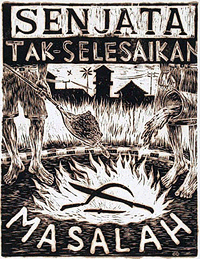 “Yogyakarta [a city in central Java] is renowned historically as a centre for radical cultural protest, particularly in the visual arts. Radical Yogya artists have embraced anti-colonial and revolutionary causes since early in the twentieth century. Like their predecessors, Taring Padi artists promote the concept of people’s art - seni kerakyatan — a loose term that defines the artist’s social commitment and popular orientation. Taring Padi attempt to put this credo into practise through concrete action, rather than just aesthetic empathy for the plight of the ‘oppressed masses.’
Mainstream art, the conventional system of curators, galleries and art collectors, is something Taring Padi avoid. Rather, they cultivate relations with other progressive organisations including students, farmers, and the urban poor. Such was the case for the World Food Day action, when Taring Padi collaborated with Mbah Seko and his group of organic farmers called Petani Lestari (Conservation Farmers), as well as with activists from the environmental non-government organisation Keliling. At the demonstration, activists shared out the protest wayangamong themselves. The cast of wayang figures symbolised the various ‘actors’ involved in the pesticide ‘drama’....
In the period before the June 1999 elections, a number of Indonesian cities experienced heightened unrest. Political commentators predicted ‘civil war,’ and the media fuelled the volatile pre-election atmosphere by nurturing perceived religious, ethnic and racial tensions. As a response, Taring Padi began to produce a series of woodcut posters which carried messages promoting solidarity and peaceful social interrelations. Between March and June 1999, they distributed approximately 10,000 woodcut posters throughout major cities in Java, Sumatra and South Sulawesi. The woodcuts, hand-printed on draft paper, were pasted on city streets, on churches and mosques, on village notice boards, in food stalls, in market places.
Among their other artwork, Taring Padi issue a popular pamphlet called The People’s Trumpet. A series of banners and murals resemble the work of Mexican muralist Diego Riviera. Taring Padi banners are often commissioned by other organisations. The women’s division of the National Human Rights Commission ordered a series of them. Titled The evacuation, the banners depict the harsh realities of the refugee crisis in Aceh by focusing on women’s daily struggles.
 But Taring Padi also use banners and murals for community purposes, and invite local people to be part of the painting process. Taring Padi’s creative ethos involves a collective, process-oriented production of artwork. They want to eliminate illusive notions of the artist as ‘genius’ or ‘eccentric’ individual, and of the artwork as somehow ‘sacred.’ Taring Padi artwork does not carry recognition of the ‘individual’ artistic creator. It is stamped instead with the Taring Padi ‘kerakyatan’ insignia — a sprig of rice, red star and cogwheel.”
See a collection of linocut prints and paintings.
Design Ignites Change
From the American Institute of Graphics Arts:
“AIGA and Worldstudio Foundation will collaborate on a number of projects in 2005.
 ‘Design Ignites Change,’ a new joint initiative of AIGA and Worldstudio Foundation is an annual program in which members of the design community across the country work individually or in teams to create together some kind of visual artifact that will have broad visibility in our communities; that will be seen as a way to emphasize the value of design by doing something valuable to the community; and that will stimulate thought, dialog and action.
The goal is to showcase the projects in a traveling exhibition with a companion book or publication that will demonstrate the impact they had in their respective communities.
We are currently seeking designers’ input on what the program should address through a short online questionnaire.
Please take just a few minutes to share your thoughts before Friday, February 11.
While project parameters are still in development, certain criteria will be important, whatever final form the program may take: the program will be nationwide, annual, should include nonprofessionals and/or young people and program themes should be topical, current and politically nonpartisan.”
While it’s great that the AIGA is compiling a collection of graphic work for social change, it’s a shame that it’s so isolated from the rest of their work. For instance, there wasn’t much at all on social change in the results of their annual competition. Just think what an engine for progress the AIGA could be if they required (or even just awarded bonus points) for printed entries submitted recycled paper, printed with non-toxic, sustainable practices.
These types of things also tend to recognize work that other designers like rather than what works best for the client or issue. But if the resulting publication inspired a designer or student or two to take on a project in the public interest, that’d be a fine thing indeed.
And while the AIGA is a 501(c)(3) non-profit corporation and can’t endorse candidates or lobby too much, the whole “politically non-partisan” thing seems increasingly like a firm vote of approval for the status quo and its consequences. Now more than ever.
In any case, it’s hopefully a full first step towards a broader embracing and encouraging design in the public interest. And it’s nice that they are open for comments. Go tell ‘em what you think.
Japan at War

Antiwar activists found not guilty over flier distribution
“The Tokyo District Court found three peace activists not guilty Thursday of trespassing at a Self-Defense Forces housing facility in the western suburbs of Tokyo and distributing leaflets in mailboxes expressing opposition to the SDF deployment in Iraq.
They were arrested Feb 27 after trespassing Jan 17 at the SDF residential quarters in Tachikawa, Tokyo, to distribute the fliers urging SDF personnel and their families to consider the appropriateness of sending Japanese troops to Iraq.”
The three spent nearly 2 1/2 months in detention.
Japanese police have become increasingly agressive in their crackdown on peaceful protestors distributing political leaflets.
More from the Japan Times:
“The Feb. 27 arrest of the three, members of local citizens’ group Tachikawa Jieitai Kanshi Tentomura (Tachikawa Tent Village to Monitor the Self-Defense Forces), shocked many civic groups and legal experts, who see it as an attempt by authorities to silence antiwar activists.
The handbills say SDF personnel may inevitably be forced to kill Iraqis and call on the service members to critically assess the government’s decision to dispatch troops to Iraq....
After returning home Tuesday night, one of the three, a 47-year-old worker at a public school in Tokyo, said the arrest and subsequent detention caused irreparable damage to his social reputation and career.
He said that on the day of his arrest, some media reported his name as a criminal suspect, and that he must stay away from work as long as his trial is ongoing.
Established in 1972, the group, which currently has seven members, has been posting handbills at the complex for the past two decades, but members claimed there had never been problems until they posted the handbills in January, drawing complaints from the residents.
...
In April last year, a 25-year-old bookstore employee was arrested for vandalism, after writing antiwar graffiti on the wall of a public lavatory at a park in Suginami Ward, Tokyo. The man said he was questioned by public security police, who grilled him over his political background.
His arrest was unusual, his counsel said, in that instead of the ward initiating a criminal complaint, police approached the ward to do so.
In February, the man was handed a suspended 14-month prison term. He has appealed the case to higher court, claiming his sentence is too harsh for the crime.
In March, a 50-year-old Social Security Agency employee was arrested and charged with violating the National Public Service Law by posting copies of the Japanese Communist Party organ Akahata in more than 100 mailboxes in Tokyo’s Chuo Ward during campaigning for November’s general election.
It is illegal for civil servants to engage openly in election-related activities, but no one has been charged with such an offense since 1967, according to legal experts, although over the years a few have been arrested.
His lawyer said it is unprecedented for a public servant to be arrested for merely posting leaflets. This case was also handled by public security investigators, who raided the man’s home, workplace and the JCP’s office in Chiyoda Ward.
‘Posting leaflets is the most peaceful means and one of the few tools powerless citizens have to convey their message,’ said Katsuko Kato, a 66-year-old cram school teacher who heads the Tachikawa citizens’ group. She added that peace activists targeting SDF bases widely employ the tactic.
‘This (renewed) oppression of citizens’ voices and the rights of those in the military to have wide access to information was something that was prevalent during the war. It reminds me that Japan is again at war,’ she added.”
Of course, article 9 of Japan’s Constitution forbids the country from engaging in war:
“Aspiring sincerely to an international peace based on justice and order, the Japanese people forever renounce war as a sovereign right of the nation and the threat or use of force as means of settling international disputes. 2) In order to accomplish the aim of the preceding paragraph, land, sea, and air forces, as well as other war potential, will never be maintained. The right of belligerency of the state will not be recognized.”
That is, the same Constitution drafted by the occupation government of the United States military in 1946.
Read more about the history of Tachikawa Tent Village to Monitor the Self-Defense Forces.
See this previous post on recruiting graphics for Japan’s Self-Defense Force.
Starring John Kerry
Back in January 2003, nearly a year before the Democratic primaries, I posted a blog entry on The Committee to Help Unsell the War, a mobilization of students and advertising agencies against the Vietnam War.
 Without my realizing it, that representative I mentioned from Vietnam Veterans Against the War who “discussed war crimes and problems veterans faced” was, in fact, John Kerry.
Milton Rosenberg, the professor of social psychology from the University of Chicago cited in the piece as “perhaps the most influential speaker,” emails:
“I was ego-surfing yesterday as I tried out the new microsoft search engine---and I came upon your longish quotation from a book that deals with the ‘Unsell the War’ and the organizing meeting that was held at Yale....
Of additional--and rather risible--interest is the reference to ‘a representative of Vietnam Veterans Against the War.’ That was John Kerry!!-- of whom I had never before heard. He stood out for his skeletal frame, his hair and his plummy brahminical accent--but not particularly for his rhetorical skill.
I too was asked to judge the resulting TV spots---but in an advisory role rather than as one of official screening panel.”
Rosenberg notes it was his book that got him invited and on which he spoke. He co-authored of Vietnam and the Silent Majority: The Dove’s Guide in 1970:
“Our book was a quick effort designed to analyze the available public opinion data and to show that the ‘silent majority’ was silent in its opposition (rather than its support, as Nixon contended) of the Vietnam war. It also offered a design for how to propagandize for early withdrawal from the war, a policy strongly urged by the Committee for a Sane Nuclear Policy on whose National Board I served at the time.”
Silicon in the Naked City

Last week, I was delighted to receive a piece of mail from the New York City Department of Sanitation.
The flyer announced a series of events around the city to collect, refurbish, and recycle old electronics in an environmentally responsible manner.
Electronic devices constitute less than one percent of the NYC waste stream, but the materials are extremely toxic if not disposed of properly.
I know non-profit and volunteer groups hold collection events from time to time, but I almost always find out about them after the fact. The refurbished computers are usually donated or sold to low-income families, schools, and community groups for a nominal fee.
This time, however, the Department of Sanitation itself is sponsoring events in the five boroughs to collect e-waste. Working cell phones are being donated to Collective Good.
The events are jointly funded by Dell and Lexmark and the National Recycling Coalition. The Lower East Side Ecology Center and other community groups are coordinating.
I asked Robert Lange, New York City’s Director of Recycling and Waste Prevention about the events:
SDN: Was this started at the initiative of the City, local groups, or manufacturers?
 Click to view a larger version |
I usually find out these things after the fact. What kind of outreach are you doing?
We sent out the flyer well in advance to every residence in the city, and posted the information on our Web site.
Is this aimed primarily at consumers or businesses or both?
It is aimed at city residences.
Will there be a similar push directed at businesses?
It’s possible.
In things like this, it depends on who picks up the tab. Does the tab get picked up by the businesses that profit from the manufacture and sale of these items? Is the tab picked up by consumers? Is some ways, ultimately, the tab is always picked up by the consumer, either directly associated as a charge with the item when they by it, or indirectly through a tax, to run a municipal program, for example.
In my own estimation, because there is an infrastructure for producing these things and delivering the products to people, it makes sense to use the same distribution network to take them back if possible.
And to some extent, Dell and other manufacturers are doing that. If you look at the flyer or the Web site, there are services currently provided by these companies for taking back computers. In some cases, there’s a nominal charge, in other cases there’s no charge, but it’s services they provide to directly take back computers from consumers after their useful life.
Given the toxicity of materials, is there a chance that the disposal may be regulated legislatively?
There are materials like this in the waste stream that are increasing in volume and they need to be addressed. Whether they need to be addressed by a municipal program or not is something that is still in question.
There are a variety of proposed pieces of legislation, both in our area and in other parts of the country to require that this material be handled in a more responsible manner. Different legislators have different perspectives on who picks up the tab.
My own opinion is that this is something that manufacturers should really be required to deal with. And to some extent they are stepping up to the plate because the funds for these drop-off programs that we are running through community-based organizations are being provided by Dell and Lexmark.
 I don’t know if you are familiar with an organization called RBRC which is for taking back batteries — particularly Nickel Cadmium batteries. It is funded and run by the battery industry. A few years ago, when the industry was facing the potential of severe regulation governing how batteries could be disposed of, all the manufacturers got together set up an informal network to receive batteries from the public. All the Radio Shacks, Staples, and organizations like that take back batteries from the public as part of the network they established. And they did that try to avoid the kind of regulation that was coming down.
I think the computer industry has an even greater incentive to do that, so I expect that what is now fairly informal will become a more formal network in the future. Either that or there will be legislation passed.
What are your future plans?
This is something of an experiment. As I said, the funds are being provided by Dell and Lexmark. Whether they will continue to provide funding... they have not made a long range commitment to that effect.
The collections will run through the fall. How we go forward will depend on the amount success we have. Events like this have been run in the City before and the average tonnage of computers and electronics received per event is approximately 10 tons. We hope to see exponentially higher numbers because this mailing is going to every household in the City.
For more information, visit the NYC Wasteless Web site.
...
And while we’re talking trash, big up to the Mayor for his plan to ship waste from Manhattan’s 59th Street pier instead of trucking it to Brooklyn and the South Bronx.This should relieve some of the burden from low-income neighborhoods who overwhelming suffer the traffic of the City’s trash.
Green Map Systems
Graphic designer Wendy Brawer produced her first Green Map in 1991. The Green Apple Map of New York City charted 143 ecologically and culturally significant sites: community gardens, parks, greenmarkets, eco-centers, green businesses and buildings, transportation options, and toxic hot spots. It was well received and quickly inspired a second edition. Wendy writes:
“This Map encourages people to explore and understand out city — helping expand our community of environmental stewards who understand the interconnections between the natural and built environments. It can help build a network of links among people of different ages and backgrounds by highlighting places that are important to our common future. It promotes and fosters replication of successful projects. Moreover, it challenges the assumption that this intensely urban setting has little redeeming ecological value.”
 Activists and designers in other cities, particularly colleagues in the o2 Global Network, were eager to make their own Green Maps.
Green Map Systems was born in 1995 and became a U.S. registered not-for-profit organization in 2000.
Wendy and her team produced a shared set of icons, and a Mapmakers’ Agreement which sets some parameters and includes small royalty based on the proceeds — 1% to 3% depending on if the project is all volunteers or has paid staff, and 1% of printed maps. Some “scholarships” are available where needed.
After that, the projects are fairly autonomous. Each Green Map is locally organized and designed, and independently produced. The maps may highlight parks and green spaces, bike paths, gay and lesbian resources, notes on wheelchair accessibility, recycling centers, or sites of energy production and consumption.
“Printed and digital Green Maps identify, promote and link eco and social resources. Each merges the ancient art of map making and new media in creating a fresh perspective that helps hometown residents discover great ways to get involved with the urban environment, and guides tourists (especially virtual ones) to special places and successful greening initiatives they can experience, and then replicate back home.
The maps are generated with a wide range of techniques, from GIS to Illustrator, to simple drawings by hand.
As of this writing, there are now there are now 241 Green Map projects, including 45 by youth. 151 different Green Maps have been completed in 39 countries. The maps are listed here.
Map makers can also develop local variations on global set of Green Map Icons (a shrine icon for Japan, a Capoira icon for Brazil.) After a global discussion on the Green Map email list, several of these have been incorporated into the global set. The set of 125 icons and 50 youth icons have been released as digital fonts for easy placement.
Launched on February 29, 2004, the Green Map Atlas highlights the ten map making projects in Asia and North America. With the goal of promoting sustainability and greener living worldwide, the Green Map Atlas showcases the work of diverse Mapmakers in Tokyo, Toronto, Jakarta, Pune (India), Kyoto, Hiroshima and Hakodate (Japan), Robeson County, NC, Milwaukee, and New York City.
Mapping Environmental Racism
Six out of eight of Manhattan’s diesel bus depots are located in northern Manhattan. Two of the city’s largest sewage treatment plants are there, too — powered by huge diesel engines running 24 hours a day. The area is flanked by highways and two major bridges over which trucks (also running on diesel) deliver goods into city into Manhattan. And the two outdoor train yards and elevated rail lines serve diesel locomotives daily.
In addition to diesel exhaust, northern Manhattan contains brownfield sites, vacant lots, and abandoned buildings posing chemical and social hazards.
On April 19, 2003, the New York Times reported on a study that found that 25.5 percent of children in Harlem have asthma — “one of the highest rates ever documented for an American neighborhood.”
Residents of northern Manhattan are predominantly black and Latino.
...
West Harlem Environmental Action is:
“a non-profit, grassroots organization working to improve environmental quality and to secure environmental justice in predominately African-American and Latino communities.
Since 1988, WE ACT has worked with citizen groups, youth, community residents, environmentalists, local/state/federal governments, and educational & medical institutions.
Based in Northern Manhattan, WE ACT advances its mission through research, public education, advocacy, mobilization, litigation, legislative affairs & sustainable economic development.”
 One of their programs is a mapping initiative using GIS to map health trends, particularly child asthma hospital admissions, air quality, and polluting facilities, as well as waterfront development and access issues.
“The first step toward environmental justice must be an awareness of the hazards. WEACT has an ongoing commitment to enhance community awareness of environmental hazards in northern Manhattan. The maps and ‘tour of hazards’ presented here are an incremental step toward the fulfillment of WEACT’s mission. They are the result of a joint project between WEACT and students from the City and Regional Planning Department at Cornell University. Cornell students created this web page based on interviews with area residents about environmental hazards in their neighborhoods.”
“On January 30, 1999, eight students, part of an Environmental Justice and GIS Workshop class with the Department of City and Regional Planning at Cornell University in Ithaca, New York, met with WE ACT staff and several community leaders to ‘address the dire lack of useful environmental justice information accessible to communities in New York, New Jersey, and Puerto Rico.’ At the time, the nascent GIS system setup in the WE ACT office was a mere four months old, and their collaboration helped to shape its growth to where it stands today!”
Their Toxic Tour links points on the map to photos documenting toxic sites and their proximity to homes and schools.
Idealist.org Nonprofit Design Contest
Found via kottke.org:
“Enter your work in the First Annual Idealist Nonprofit Design Contest. Winning entries will be showcased in an online gallery on the Idealist.org website and in an exhibition in New York City. In addition, winning entries—gold, silver, bronze, and student in each category—will receive prizes donated by our sponsors.
Gold winning entries will receive Apple laptop computers donated by Aladdin Knowledge Systems. Silver winning entries will receive 15GB iPods donated by Tekserve and other sponsors.
This competition seeks to promote excellence in design in the nonprofit sector and to reward and acknowledge those designers who move beyond limitations to create works that are functional and aesthetically powerful while also promoting social impact.
Any work implemented for a nonprofit that fits in the categories of web, print, or multimedia and was completed between January 1, 2003 to August 31, 2004 can be submitted. Each work MUST be accompanied by its client’s information, including the organization’s name, mission, a copy of the organization’s tax exempt certification or its latest newsletter or brochure, and contact information for a person from the organization.
The entry fee is $25 per entry for those located in the United States. Submissions mailed from outside the U.S. do not require a fee. The deadline is August 31, 2004. Please make your check payable to Action Without Borders and include it with your entry. Entries from the U.S. that are received without payment will not be considered in the contest. Entry fees are nonrefundable.
The jury is being finalized, but will ultimately include both nonprofit and design professionals.
To the Streets
I wrote the essay below for the Design Issues column in the May/June 2004 issue of Communication Arts. I profile a couple of folks using graphic design for advocacy. I didn’t call it out explicitly in the text, but it’s of some relevance that the projects here are generally not pro-bono projects “for charity,” but are organizations started by designers generally working with broader communities. Check it out.
Taking it to the Streets
Graphic design for advocacy
Walking the streets of New York City in February 2003, one couldn’t help but notice all these little blue stickers. Stuck to walls, phone booths, bus stops, scaffolding, mail boxes — they popped up everywhere to announce the February 15 march against President Bush’s invasion of Iraq.
The blue stickers were just one of the many anti-war graphics circulating at the time. Around the Web, activists were posting free, easy-to-print designs using a variety of techniques: clever slogans, typographic play, dramatic photos and the ironic use of vintage propaganda imagery.
But the February 15 stickers on the streets of New York were different — simple and bold, a little blue banner announcing the time and place of the march. They did not make an emotional appeal with pictures of scarred and armless Iraqi children or U.S. soldiers, nor was there any argument about why the war was wrong.
The February 15 posters were not intended to change people’s minds in a direct way, but to notify the public about the upcoming protest — and to make dissent visible. The mainstream media had entirely avoided covering the anti-war movement prior to February 15. In the face of this de facto censorship and police obstruction over the route of the march, the stickers acted as thousands of little acts of civil disobedience. And with the urban landscape as a medium, the stickers set the stage for even larger acts of defiance.

